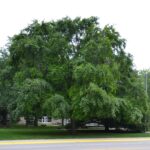
Tree Indiana Native Audio Recording AvailablePurdue Plant Doctor Available Fraxinus pennsylvanica [Green Ash] Produces many weed seedlings, except for seedless cultivars. An unattractive ash flower gall (formed by mites) can develop on male flowers and persists into winter. Emerald Ash Borer is severely affecting all species of this genus. Damage can be prevented with the appropriate pesticide, but the treatment cost will eventually exceed replacement cost. See the Purdue Landscape Report article: Should ash trees still be protected from emerald ash borer? for more information. Indiana NativeAudio Recording AvailablePurdue Plant Doctor Available
Tree Indiana Native Fraxinus profunda [Pumpkin Ash] Emerald Ash Borer is severely affecting all species of this genus. Damage can be prevented with the appropriate pesticide, but the treatment cost will eventually exceed replacement cost. See the Purdue Landscape Report article: Should ash trees still be protected from emerald ash borer? for more information Indiana Native
Tree Indiana Native Audio Recording AvailableID That Tree Video AvailablePurdue Plant Doctor Available Fraxinus quadrangulata [Blue Ash] The Blue Ash earned its common name from the blue dye early Americans made from its inner bark, which contains a substance that turns blue when exposed to air. This tree is naturally found upland in dry, rocky limestone areas and is very drought-tolerant. As with all ashes, Fraxinus quadrangulata is extremely susceptible to the Emerald Ash Borer. Damage from this pest can be prevented with the imidacloprid soil drench method, but the annual treatment… Indiana NativeAudio Recording AvailableID That Tree Video AvailablePurdue Plant Doctor Available
Tree Indiana Native ID That Tree Video AvailablePurdue Plant Doctor Available Gleditsia aquatica [Water Locust] This native Indiana tree species is found in three southwestern counties near the lower Wabash River. It is often found in wet or ponded locations where there is standing water or high water tables. Not recommended for the landscape as it has large, multi-pronged thorns. Like its cousin, the honey locust, it has compound leaves, but can be differentiated by its location, much smaller seed pods, and flattened thorns along the branches. Indiana NativeID That Tree Video AvailablePurdue Plant Doctor Available
Tree Indiana Native ID That Tree Video AvailablePurdue Plant Doctor Available Gleditsia triacanthos [Honeylocust] This thorny native Indiana tree species is a moderately fast-growing tree commonly found on moist bottomlands or limestone soils. It is not recommended for homes or businesses due to the potential for injury from the thorns. Despite its large thorns, it is very hardy and tolerant of drought and salinity. The thornless variety Gleditsia triacanthos f. inermis has been planted to replace the elm in many urban areas. Honeylocust pods are sweet and eaten by… Indiana NativeID That Tree Video AvailablePurdue Plant Doctor Available
Tree Indiana Native Audio Recording AvailablePurdue Plant Doctor Available Gleditsia triacanthos f. inermis [Thornless Common Honeylocust] This large tree has finely compound leaves that provide a pleasant, dappled shade in the summer. The thornless forma inermis is only sold in commerce, as the profuse thorns of the species type can be a liability. Mimosa webworm and locust mite are serious pests in the Midwest, and are becoming more serious (especially in areas tending toward monoculture). Can be controlled with spraying. Indiana NativeAudio Recording AvailablePurdue Plant Doctor Available
Tree Indiana Native Audio Recording AvailableID That Tree Video Available Gymnocladus dioicus [Kentucky Coffeetree] Gymnocladus dioicus is a large deciduous tree with strong winter character from the branches and bark. Drops pods (female trees) and twigs, frequently causing litter problem, thus eliminating the straight species as a good street tree. Seeds were once used by US settlers as a coffee substitute, however pulp and seeds are toxic when not properly and completely roasted. Indiana NativeAudio Recording AvailableID That Tree Video Available
Shrub/Tree Indiana Native Audio Recording AvailableID That Tree Video AvailablePurdue Plant Doctor Available Hamamelis virginiana [Common Witchhazel] Flowers are in evidence because of their spicy fragrance before they are visually obvious, but are fairly showy after leaf drop. Should not be pruned (tip pinching would be acceptable to direct growth). Indiana NativeAudio Recording AvailableID That Tree Video AvailablePurdue Plant Doctor Available
Shrub Indiana Native Audio Recording AvailableID That Tree Video AvailablePurdue Plant Doctor Available Hydrangea arborescens [Smooth Hydrangea] The Smooth Hydrangea is an Indiana native found along woodlands and waterways with rocky soils. The flowers of Hydrangea arborescens can be large and heavy, bending stems to the ground. Best used in a shady area or along foundations of buildings for some support. This plant often gets cut back hard to the ground in late winter to maintain a neat look and to promote vigorous flowering the following summer. Hydrangea arborescens is a fast… Indiana NativeAudio Recording AvailableID That Tree Video AvailablePurdue Plant Doctor Available
Shrub Indiana Native Audio Recording AvailablePurdue Plant Doctor Available Hypericum prolificum [Shrubby St. John's Wort] Hypericum prolificum is a compact, rounded Indiana native shrub. The attractive bright yellow flowers, appearing in summer, are unique and crowned by a dome of many long stamens. This species can suffer in hot and humid environments, causing it to become prone to root rot and wilt. Indiana NativeAudio Recording AvailablePurdue Plant Doctor Available