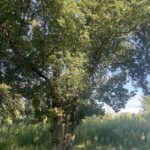
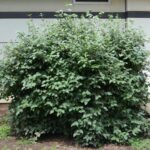
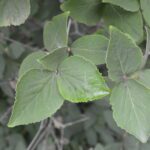
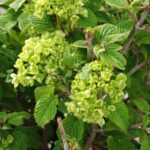
Tree Ulmus parvifolia 'Emer II' [sold as Allee®] [Allee Lacebark Elm] Stunning, multi-colored mottled and exfoliating bark, even on the surface roots. Tends to maintain foliage well during droughts. Grows well under city conditions. Resistant to Dutch elm disease and the elm leaf beetle.
Tree Ulmus parvifolia 'UPMTF' [sold as Bosque®] [Bosque Lacebark Elm] Stunning, multi-colored, mottled, and exfoliating bark. Grows well under city conditions. Good resistance against Dutch elm disease, elm leaf beetle, and Japanese beetle. Slightly weak wooded, sometimes damaged by ice storms.
Tree Indiana Native Ulmus rubra [Slippery Elm] The Slippery Elm has a vase-shaped form, similar to that of the American Elm (Ulmus americana), but with more ascending branchlets. This tree gained its common name from the moist, slippery, red inner bark chewed by Native Americans and pioneers to quench thirst. Not considered very ornamental for the landscape, due to its coarse texture, weedy tendencies, and susceptibility to Dutch Elm Disease (although not as severe as the American Elm).
Tree Ulmus × 'Frontier' [Frontier Elm] Small tree that grows well under city conditions. Good Dutch elm disease resistance and moderate elm leaf beetle resistance.
Shrub Viburnum × burkwoodii 'Chenaultii' [Chenault Burkwood Viburnum] 'Chenaultii' has a finer-textured, more delicate appearance than the species type due to its smaller leaves and thinner branches. Trouble-free plant tolerant of soils and pollution (except sulfur). Also, does not tolerate more severe drought. Very fragrant when in bloom, although to a lesser degree than Viburnum carlesii (Koreanspice Viburnum). Bacterial spot and powdery mildew susceptibility (but not always a problem). Sulfur containing pesticides burn or defoliate leaves. Too thin to be a solid screen.
Shrub Viburnum × carlcephalum 'Cayuga' [Cayuga Viburnum] Cayuga Viburnum is a backcross between V. x carlcephualum and V. carlesii, known for its fragrant flowers and upright to slightly spreading habit. Pink buds open to clusters of white fragrant flowers in May. Leaves change from a dark green to a vibrant orange-red in the fall. Bacterial leaf spot can be a problem in some settings. Prune immediately after flowering for best flower show the next year.
Shrub Viburnum carlesii [Koreanspice Viburnum] Very fragrant when in bloom. Bacterial leaf spot can be a problem in some settings. Prune immediately after flowering for best flower show the next year.
Shrub Viburnum carlesii 'Compactum' [Compact Koreanspice Viburnum] 'Compactum' is a dwarf cultivar, maxing the height around 3-4 feet in height. Flowers are similar in size to straight species. Very fragrant when in bloom. Bacterial leaf spot can be a problem in some settings. Prune immediately after flowering for best flower show the next year.
Shrub Viburnum × juddii [Judd Viburnum] The Judd Viburnum is a hybrid of Viburnum carlesii (Koreanspice Viburnum) and V. bitchiuense (Bitchiu Viburnum), and is considered a better choice for the landscape than both parent species. Very fragrant when in bloom. V. juddii has good resistance towards bacterial leaf spot, unlike V. carlesii. Prune immediately after flowering for best flower show the next year.
Shrub Viburnum lantana [Wayfaringtree Viburnum] The Wayfaringtree is a coarse-textured large shrub noted for its abundance of showy flowers and colorful fruits. Plant in groups with different clones for best fruit set. Has escaped cultivation and naturalized in some areas of the United States.