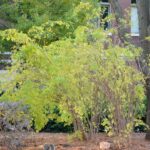
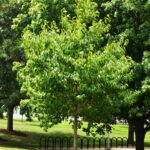
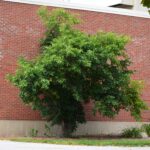
Tree Indiana Native Diospyros virginiana [Common Persimmon] Most are usually dioecious and have a deep tap root which makes large plants difficult to transplant. Flowers attract bees while the fruit attracts birds and many mammals. The fruit is astringent when green, sweet and edible when ripe. Fruits, twigs, and leaves can be a littler problem.
Tree Diospyros virginiana 'Meader' [Meader Persimmon] Most usually dioecious. Flowers attract bees. Fruit attracts birds and many mammals. The fruit is astringent when green, sweet and edible when ripe. Fruits, twigs, and leaves can be a littler problem. Deep tap root makes large plants difficult to transplant. Can be poisonous to horses. ‘Meader’ is a self-fertile cultivar usually producing fruit after 2-3 years.
Shrub Indiana Native Dirca palustris [Leatherwood] Dirca palustris is a small, dense, quite rounded, Indiana native shrub with excellent yellow fall coloration. Although it is generally uncommon in the wild, Leatherwood can be found growing naturally and thriving along the ravines of Turkey Run State Park in Marshall, IN. This plant requires rich, moist, acidic soils and should be protected from intense sun. Leatherwood fruits, bark, and roots are poisonous.
Shrub/Tree InvasiveThis plant is considered invasive Elaeagnus angustifolia [Russian-olive] Widely adaptable and invasive plant in the Midwest. Like other members of the family, fixes atmospheric nitrogen. Can be a large shrub or small tree. Spreads by rooting suckers. Especially tolerant of extreme cold and drought, but does not tolerate extreme heat of the south. Verticillium wilt and stem canker may be a problem in some areas. Needs some pruning to keep vigorous and in good form. Berries used to make sherbet in some parts…
Shrub Eleutherococcus sieboldianus [Fiveleaf Aralia] Tolerates a wide range of soil and environmental conditions, including dry city conditions and shade. Little seasonal interest other than foliage, but extremely durable shrub. Prickles on stems can make pruning difficult. In poor sites, renewal pruning can improve form. In rich organic soils, renewal pruning can lead to rank growth. Usually dioecious.
Tree Eucommia ulmoides [Hardy Rubber Tree] The Hardy Rubber Tree is an adaptable, relatively trouble-free plant that makes for an excellent shade tree. Its sap can be harvested for rubber, but this is an expensive and complex process. The specific epithet (ulmoides) refers to the leaf shape of the Elm genus (Ulmus), which is similar to that of Hardy Rubber Tree leaves. It is the only member of this family. Contains about 3% rubber content on a dry weight basis. It…
Shrub InvasiveThis plant is considered invasive Euonymus alatus [Winged Euonymus] Widely tolerant of most soil and microclimatic conditions, but develops good fall foliage color only when exposed to considerable direct sun. Tolerates heavy pruning. Can be troubled by scale insects, although not so frequently as the evergreen euonymus. Fruits are toxic. Avoid very dry or wet sites. Can be invasive, seeding into woodlots.
Shrub InvasiveThis plant is considered invasive Euonymus alatus 'Compactus' [Dwarf Winged Euonymus] The dense and lower-growing 'Compactus' is one of the most common Winged Euonymus cultivars. Widely tolerant of most soil and microclimatic conditions, but develops good fall foliage color only when exposed to considerable direct sun. Tolerates heavy pruning. Can be troubled by scale insects, although not so frequently as the evergreen euonymus. Fruits are toxic. Avoid very dry or wet sites. Can be invasive, seeding into woodlots.
Shrub/Tree Euonymus europaeus [Common Spindle Tree] Euonymus europaeus is an adaptable small tree (sometimes large shrub) that can spread and become invasive. The Common Spindle Tree's primary ornamental interest is its attractive and interesting fruits in the fall. Unfortunately, this tree can otherwise be quite unattractive, irregular, and spindley.
Liana (Climbing Vine) InvasiveThis plant is considered invasive Euonymus fortunei [Wintercreeper Euonymus] Best in soil that is reasonably moist, either in full sun or shade, but not heavy wet soils. Can be used as a wall climber (possibly climbing up to 70') or groundcover. Subject to Euonymus Scale that can kill some plants, especially 'Vegetus' and 'Coloratus'. Euonymus fortunei is a vigorous vine that invades forest openings and margins. It grows across the ground, displacing herbaceous plants and seedlings and climbs trees high into the tree canopy…