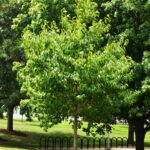
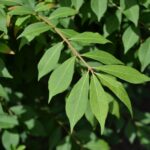
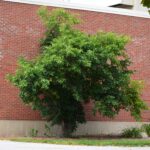
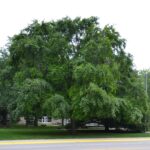
Tree Eucommia ulmoides [Hardy Rubber Tree] The Hardy Rubber Tree is an adaptable, relatively trouble-free plant that makes for an excellent shade tree. Its sap can be harvested for rubber, but this is an expensive and complex process. The specific epithet (ulmoides) refers to the leaf shape of the Elm genus (Ulmus), which is similar to that of Hardy Rubber Tree leaves. It is the only member of this family. Contains about 3% rubber content on a dry weight basis. It…
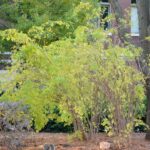
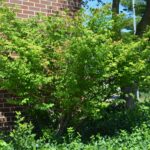
Shrub InvasiveThis plant is considered invasive Euonymus alatus [Winged Euonymus] Widely tolerant of most soil and microclimatic conditions, but develops good fall foliage color only when exposed to considerable direct sun. Tolerates heavy pruning. Can be troubled by scale insects, although not so frequently as the evergreen euonymus. Fruits are toxic. Avoid very dry or wet sites. Can be invasive, seeding into woodlots.
Shrub InvasiveThis plant is considered invasive Euonymus alatus 'Compactus' [Dwarf Winged Euonymus] The dense and lower-growing 'Compactus' is one of the most common Winged Euonymus cultivars. Widely tolerant of most soil and microclimatic conditions, but develops good fall foliage color only when exposed to considerable direct sun. Tolerates heavy pruning. Can be troubled by scale insects, although not so frequently as the evergreen euonymus. Fruits are toxic. Avoid very dry or wet sites. Can be invasive, seeding into woodlots.
Shrub/Tree Euonymus europaeus [Common Spindle Tree] Euonymus europaeus is an adaptable small tree (sometimes large shrub) that can spread and become invasive. The Common Spindle Tree's primary ornamental interest is its attractive and interesting fruits in the fall. Unfortunately, this tree can otherwise be quite unattractive, irregular, and spindley.
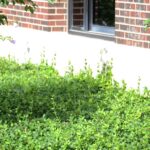
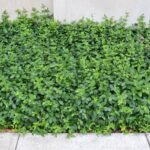
Liana (Climbing Vine) InvasiveThis plant is considered invasive Euonymus fortunei [Wintercreeper Euonymus] Best in soil that is reasonably moist, either in full sun or shade, but not heavy wet soils. Can be used as a wall climber (possibly climbing up to 70') or groundcover. Subject to Euonymus Scale that can kill some plants, especially 'Vegetus' and 'Coloratus'. Euonymus fortunei is a vigorous vine that invades forest openings and margins. It grows across the ground, displacing herbaceous plants and seedlings and climbs trees high into the tree canopy…
Liana (Climbing Vine) InvasiveThis plant is considered invasive Euonymus fortunei 'Coloratus' [Coloratus Wintercreeper Euonymus] Can tolerate full sun to full shade. Best in soil that is reasonably moist, but not heavy or wet. Can be used as a wall climber, but is best as a groundcover. This vigorous form turns purplish-plum during the winter months. Can be subject to Euonymus Scale. Euonymus fortunei is a vigorous vine that invades forest openings and margins. It grows across the ground, displacing herbaceous plants and seedlings and climbs trees high into the…
Shrub Euonymus fortunei 'Vegetus' [Vegetus Wintercreeper Euonymus] This cultivar has a more shrub-like habit than the species type, but can be moderately effective as a groundcover or wall climber. Also much heavier fruiting than the straight species; the fruiting display can be quite attractive, if fruits are borne in high enough numbers. Very susceptible to Euonymus Scale.
Shrub/Tree Euonymus planipes [Siberian Spindletree] The Siberian Spindletree is a large shrub (or sometimes small tree) that has showy 4-lobed, crimson fruits appearng in late summer followed by handsome red fall color. Plant can be affected by scale.
Tree Indiana Native Fagus grandifolia [American Beech] In a proper site, an excellent trouble-free shade tree with year-round interest. Less adaptable to hot, dry conditions than the exotic F. sylvatica, but somewhat more cold hardy. F. grandifolia is preferred in Zone 4. Like F. sylvatica, this tree is so shallow rooted and casts such heavy shade that grass does not grow well beneath it. Low branching habit is a concern for use in the tree lawn as a street tree (may require…
Tree Fagus sylvatica [European Beech] In a proper site, an excellent trouble-free shade tree with year-round interest. More adaptable to hot, dry conditions than our native F. grandifolia, but somewhat less hardy. F. grandifolia is preferred in Zone 4. Like F. grandifolia, this tree is so shallow rooted and casts such heavy shade that grass does not grow well beneath it. Low branching habit is a concern for use in the tree lawn as a street tree (may require more…