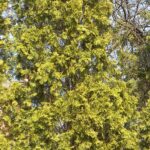
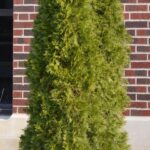
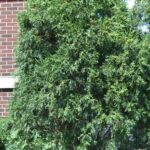
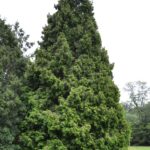
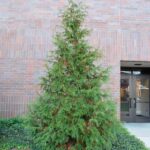
Shrub Thuja occidentalis 'Minima' [Dwarf Eastern Arborvitae] 'Minima' is a dense, compact, globe-shaped dwarf cultivar. Bagworms can be a problem. Subject to several other insect pests, all of which usually can be controlled with timely spraying. Deer may feed on foliage. Winter color can be poor.
Tree Thuja occidentalis 'Nigra' [Nigra Eastern Arborvitae] 'Nigra' is a pyramidal to conical form with handsome deep green foliage that holds its color through winter. One of the best plants for screening in moist, well-aerated soils. Bagworms can be a problem. Subject to several other insect pests, all of which usually can be controlled with timely spraying. Deer may feed on foliage.
Shrub Thuja occidentalis 'Ohlendorffii' [Dwarf Eastern Arborvitae] 'Ohlendorfii' is a broadly mounded cultivar that exclusively has the needle-like juvenile foliage. Bagworms can be a problem. Subject to several other insect pests, all of which usually can be controlled with timely spraying. Deer may feed on foliage. Winter color can be poor.
Shrub/Tree Thuja occidentalis 'Pyramidalis' [Pyramidal Eastern Arborvitae] 'Pyramidalis' has a narrow pyramidal form and brightly-colored, soft leaves. One of the best plants for screening in moist, well-aerated soils. Bagworms can be a problem. Subject to several other insect pests, all of which usually can be controlled with timely spraying. Deer may feed on foliage. Winter color can be poor (susceptible to winter burn).
Shrub/Tree Thuja occidentalis 'Smaragd' [Emerald Green Arborvitae] 'Emerald' is a very narrow, tight pyramidal cultivar that maintains excellent vertical sprays of bright, emerald green foliage throughout the year. Very heat tolerant and cold hardy. One of the best plants for screening in moist, well-aerated soils. Bagworms can be a problem. Subject to several other insect pests, all of which usually can be controlled with timely spraying. Deer may feed on foliage.
Shrub/Tree Thuja occidentalis 'Techny' [Techny Eastern Arborvitae] 'Techny' has a conical to pyramidal habit with a broad base. The deep green foliage maintains its color through winter. One of the best plants for screening in moist, well-aerated soils. Bagworms can be a problem. Subject to several other insect pests, all of which usually can be controlled with timely spraying. Deer may feed on foliage.
Shrub Thuja occidentalis 'Wareana' [Dwarf Eastern Arborvitae] 'Wareana' is a compact, pyramidal cultivar with thick, heavy, blue-green foliage that holds its color through winter. Extremely winter hardy. Bagworms can be a problem. Subject to several other insect pests, all of which usually can be controlled with timely spraying. Deer may feed on foliage.
Tree Thuja plicata 'Elegantissima' [Elegant Giant Arborvitae] One of the best plants for screening when grown in wet, but not saturated soils. An important timber tree in the western US. Subject to several pests (especially bagworms), all of which usually can be controlled with timely spraying.
Tree Thuja plicata 'Green Giant' [Green Giant Arborvitae] Green Giant Arborvitae is one of the best plants for screening when grown in wet, but not in saturated soils. The straight species was an important timber tree in the western US. Subject to several pests (especially bagworms), all of which usually can be controlled with timely spraying.
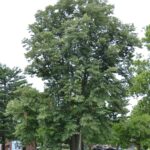
Tree Indiana Native Tilia americana [American Linden] Very adaptable, even in alkaline soil, but does not tolerate much air pollution. Too big for most urban landscapes. Japanese beetles like feeding on it.