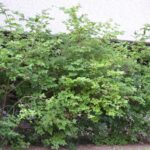
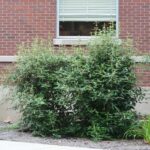
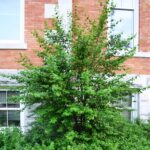
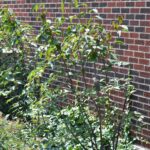
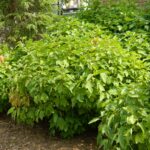
Shrub/Tree Indiana Native Viburnum lentago [Nannyberry Viburnum] The Nannybery can be grown as a large, suckering shrub or small tree and is noted for its white flower cymes and edible berries. The flower buds for the following year are formed in the summer, so if pruning is desired, it should be completed immediately after flowering.
Shrub Viburnum opulus [European Cranberrybush Viburnum] Widely tolerant of soils and microclimates, although found in more wet sites in wild stands. May be troubled by aphids. The snowball variety, V. opulus 'Roseum', is badly troubled by aphids. Prune on a 3-year cycle to maintain best form and fruiting. Flower cymes have an outer showy and sterile ring and an inner inconspicuous and fertile cluster which produces the berries.
Shrub Viburnum opulus 'Compactum' [Dwarf European Cranberrybush Viburnum] 'Compactum' is a dense, dwarf cultivar that produces an abundance of flowers and fruits and has excellent fall color. Widely tolerant of soils and microclimates, although found in more wet sites in wild stands. May be troubled by aphids. Prune on a 3-year cycle to maintain best form and fruiting. Flower cymes have an outer showy and sterile ring and an inner inconspicuous and fertile cluster which produces the berries.
Shrub Viburnum × 'Pragense' [Prague Viburnum] More drought tolerant than most Viburnums. Topping may be needed initially to encourage branching. This hybrid arose in Prague, Czechoslovakia in the 1950s.
Shrub/Tree Indiana Native Viburnum prunifolium [Blackhaw Viburnum] Widely tolerant of different soils and exposures. Transplants well. Relatively trouble-free. Can be pruned to form a nice hedge. Scale and borers are occasional problems. The edible fruits are sweet and can be eaten fresh, or used in jams and preserves.
Shrub Viburnum prunifolium 'Mrs. Henry Large' [Mrs. Henry Large Blackhaw Viburnum] 'Mrs. Henry Large' is quite rare and unlikely to be found in commerce. Widely tolerant of different soils and exposures. Transplants well. Relatively trouble-free. Can be pruned to form a nice hedge. Scale and borers are occasional problems. The edible fruits are sweet and can be eaten fresh, or used in jams and preserves.
Shrub Viburnum setigerum [Tea Viburnum] The Tea Viburnum is most noted for its truly outstanding fruit display. In autumn, branches are heavily laden with large clusters of striking bright red oval berries. For optimal fruit production, plant in groups. Can be quite open and leggy; it is advisable to plant other, shorter, plants in front of the Tea Viburnum. Gained its common name from the fact that the leaves were once used to make tea.
Shrub Viburnum trilobum 'Alfredo' [Dwarf American Cranberrybush Viburnum] 'Afredo' is a dense, compact cultivar, only reaching 5-6 feet high and wide, with excellent red fall color. It has some aphid resistance, compared to the species type. Widely tolerant of soils and microclimates. Drought resistance is not good. Fruits are used in preserves.
Liana (Climbing Vine) Vinca major 'Variegata' [Variegated Greater Periwinkle] The Greater Periwinkle is very similar to the Common Periwinkle (Vinca minor), except it is overall larger and less cold hardy, only marginally hardy in USDA zones 5 and 6. 'Variegata' has irregular, creamy white markings along leaf margins. A great evergreen ground cover for shady locations. Spreads quickly after establishment in warmer climates. Does best with regular watering on well-drained soil. Prune back in the spring.
Liana (Climbing Vine) InvasiveThis plant is considered invasive Vinca minor [Common Periwinkle] One of the best evergreen ground covers for a shady location. Spreads quickly after establishment. Subject to stem-rot disease when grown vigorously and in wet soil. Also does not like very dry soil and full sun. Does best with regular watering on well-drained soil.