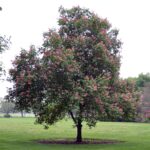
Tree Aesculus × carnea 'Briotii' [Ruby Red Horsechestnut] Has decent tolerance to drought and urban environments. Buds are not as sticky as its parent plant, Aesculus hippocastanum. Flower panicles are larger than both parent species with a rich red coloration, making it a popular tree choice in England.
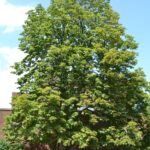
Tree Aesculus hippocastanum 'Baumannii' [Baumann Common Horsechestnut] 'Baumannii' is known for its large panicles of double flowers. The flowers are sterile, so none of the large, littering, poisonous fruit of the species type are produced, increasing this tree's usability. Widely adapted to soils and environments; however, very dry conditions must be avoided. Leaf blotch often disfigures foliage.
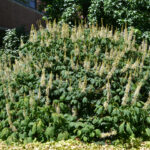
Shrub Indiana Native Aesculus parviflora [Bottlebrush Buckeye] Can be kept at a smaller size for a time with careful pruning, but it will in time occupy much space. Tolerates some shade, and can even be attractive under large shade trees. Suckers quite freely.
Shrub Agave americana [Century Plant] Can take as few as 10 years to flower in warm climates, to 60 years in colder climates. Once it flowers, it dies and offsets around the base of the original plant eventually form a group of new plants. Suckers produced from the main plant may take only 10-15 years to flower. Beware of thick point tips on its leaves, prune off to protect children. Some susceptibility to Agape weevil, especially when weakened.
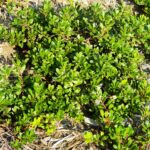
Shrub Indiana Native Arctostaphylos uva-ursi [Bearberry] Hard to establish, can develop winter burn from sun and wind when cold. Does not like excessive summer heat. Can develop foliar diseases (leaf spot) when stressed. Leaves are used to make a tea in some parts of Russia, where it is known as Kutai and Caucasian Tea. The dried leaves have been used to treat diseases of the bladder and kidney, and inflammatory diseases.
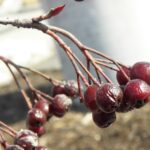
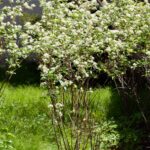
Shrub Indiana Native Aronia arbutifolia [Red Chokeberry] Red Chokeberry is often a multi-stem shrub that's native to Indiana as well as Eastern North America to Minnesota and south as far as Texas. This shrub bears white to slightly pinkish flowers with prominent anthers that gives it a unique look. Red berries form in September to often December. Best grown in mass plantings or for a naturalizing species in the landscape. Though the berries are bitter to taste, they are often used in…
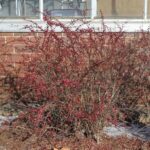
Shrub Aronia arbutifolia 'Brilliantissima' [Brilliant Red Chokeberry] The Brilliant Red Chokeberry has dark green leaves that turn a stunning deep red in the fall. 'Brilliant' produces larger and more abundant flowers and a greater number of red berries than the species type. Because birds find the fruits unappealing, the berries are allowed to persist well into the winter months. This plant tends to sucker and create colonies.
Shrub Aronia arbutifolia 'Erecta' [Erecta Red Chokeberry] 'Erecta' has a more upright form than the species and does not bear as colorful of fruit
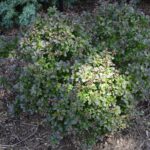
Shrub InvasiveThis plant is considered invasive Berberis thunbergii var. atropurpurea [Purple Japanese Barberry] This variety has purple to red summer foliage, turning a rich red to red-violet in the fall. It is an adaptable plant that does well in an urban environment. Place in a high light location for best foliage coloration. Can be coppiced, with the resulting new growth developing better summer color. Can be pruned to ground every 5 to 7 years. Relatively trouble-free.
Shrub InvasiveThis plant is considered invasive Berberis thunbergii var. atropurpurea 'Crimson Pygmy' [Red Dwarf Japanese Barberry] The Red Dwarf Japanese Barberry is exceedingly popular due to its dense, low growing form, brilliant foliage, and tolerance to tough urban conditions. For the best leaf coloration, place in full sun. This plant tolerates dry soils, but will suffer in wet, poorly drained soils.