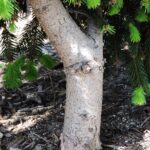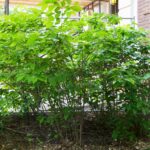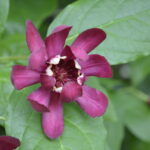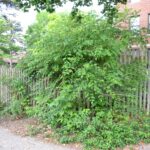
Shrub Calycanthus floridus [Common Sweetshrub] The Common Sweetshrub was one of the first native plants in the US used as an ornamental. Widely adapted to soil and sun or shade. Certain selections can permeate an area with fragrance. Can be forced for indoor fragrance. Not all plants have equally fragrant flowers; don't use seed propagated plants for that reason. Seeds are poisonous, causing convulsions, myocardial depression, and hypotension.
Shrub Calycanthus floridus 'Aphrodite' [Aphrodite Sweetshrub] 'Aphrodite' has an upright form with deep red flowers. The flowers are fragrant and large and bloom throughout the summer season. Large bright green leaves, can grow to be bigger than a human hand.
Liana (Climbing Vine) Campsis radicans [Common Trumpetcreeper] Very tolerant of soils and environment, except it does not tolerate shade. Can be trained as a standard. May require special support on some surfaces, especially as it becomes large and heavy (could pull down weaker structures). May also require pruning to keep size in check.
Tree Carnegiea gigantea [Saguaro] Arms form only after the plant reaches 50 or 60 years old. Plants may live 200 years. The ribs expand or contract depending on the amount of water being stored. Found mostly on gravelly slopes. Gila woodpeckers make their homes in the trunk. Young plants need protection from sun. Transplant readily but more difficult with older plants. State flower of Arizona. Protected. Must be transplanted from construction site. Transplant with same orientation to sun as…
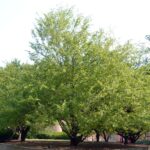
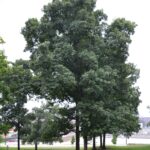
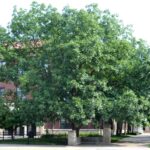
Tree Indiana Native Carpinus caroliniana [American Hornbeam] A clean, trouble-free small tree, useful in intensive situations such as patios and malls, and equally interesting in naturalized plantings. Useful as a large hedge if coppiced when young. Performs well in heavy shade and tolerates periodic flooding. Difficult to transplant. Move balled-and-burlapped for best results. Sometimes called Blue Beech and Ironwood (although these are best not used).
Tree Carpinus caroliniana 'CCSQU' [sold as Palisade®™] [Palisade®] Palisade is an upright, narrow, oval habit cultivar that is noted for its strongly ascending branches. Its dark green leaves changes to a soft golden color in the fall. A clean, trouble-free small tree, useful in intensive situations such as patios and malls, and equally interesting in naturalized plantings. Useful as a large hedge if coppiced when young. Performs well in heavy shade and tolerates periodic flooding. Difficult to transplant. Move balled-and-burlapped for best results.
Tree Indiana Native Carya glabra [Pignut Hickory] With its straight trunk and strong, hard wood, the Pignut Hickory is most commonly grown for the lumber industry and is not generally used as an ornamental tree. In the wild, it tends to grow on ridges and hillsides in dry to moist soils. This large tree needs a great deal of room to grow and transplants poorly due to its large taproot. The nuts are generally too bitter for humans to eat, but are…
Tree Indiana Native Carya ovata [Shagbark Hickory] The bark of Carya ovata gives the tree its common name and is characteristically rough and shaggy on mature trees, growing in long flat plates, making especially good winter interest. The wood of this tree is especially hard, making it useful for a variety of products. This tree develops a large taproot, making it difficult to transplant.
Tree Carya × nussbaumeri [Hican] This tree is a hybrid of the pecan and shellbark hickory, thus the common name of "Hican". It was developed to produce a nut with the taste of pecans, but with the weaker shell of the shellbark hickory. This plant has a large tap root and can be difficult to transplant. Dropped fruits, stems, and leaves can be a litter problem. Can be prone to various fungal leaf spots.
Shrub Caryopteris × clandonensis [Bluebeard] Is often killed to ground in winter, returning to flower in the same year. Functions much like an herbaceous perennial, primarily for flowering interest, blooming on new growth. This hybrid is much hardier than C. incana and much more showy than C. mongholica. Prefers full sun but tolerates partial shade. Attractive plant to bees, butterflies, and hummingbirds. Occasionally kills out completely at the northern edge of its useful range, with tops regularly killed back to…