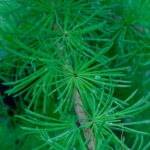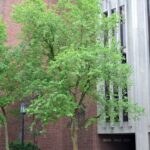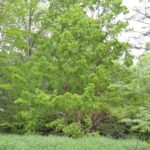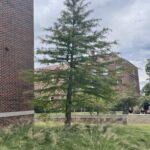
Tree Indiana Native Audio Recording AvailableID That Tree Video AvailablePurdue Plant Doctor Available Larix laricina [Eastern Larch] The Eastern Larch, or more commonly referred to as Tamarack, is a cold hardy deciduous pine found in northern portions of Canada, Alaska, and as far south as Minnesota, Illinois, and Pennsylvania. The Tamarack grows in particularly moist soils and is salt tolerant. It grows open and pyramidal with a slender trunk, and has horizontal and drooping branchlets. During the fall, its soft, blueish-green needle-like leaves turn a rich, golden color. This tree does best… Indiana NativeAudio Recording AvailableID That Tree Video AvailablePurdue Plant Doctor Available
Tree Indiana Native Audio Recording AvailableID That Tree Video Available Maclura pomifera [Osage-Orange] Withstands wind and dry conditions well. Used by farmers as a hedgerow for livestock fencing because of its thorniness. Highly deer resistant. Fruits are said to be an insect and rodent repellent. Extremely decay resistant wood, containing 1% by weight 2,3,4,5-tetrahydroxystilbene (a fungitoxic compound). Large fruits create litter problem; select staminate trees to avoid fruit (unless you believe the fruits are of interest). Due to invasive root system, do not plant near sewer or drainage… Indiana NativeAudio Recording AvailableID That Tree Video Available
Tree Audio Recording Available Metasequoia glyptostroboides [Dawn Redwood] More tolerant of different sites than Taxodium distichum (Common Baldcypress). Prefers moist sites and can grow in water. Japanese beetles will feed on foliage. Does not like chalky soils with high pH. Audio Recording Available
Tree Metasequoia glyptostroboides 'Sheridan Spire' [Sheridan Spire Dawn Redwood] 'Sheridan Spire' is more narrow and upright than the straight species. Metasequoia glyptostroboides is more tolerant of different sites than Taxodium distichum (Common Baldcypress). Prefers moist sites and can grow in water. Japanese beetles will feed on foliage. Does not like chalky soils with high pH.
Herbaceous Purdue Plant Doctor Available Monarda didyma 'Petite Delight' [Petite Delight Bee Balm] Bee Balm has 15 species and is native to the prairies and woodlands in North America. The name Bee Balm comes from making a balm from the leaves for bee stings. 'Petite Delight' spreads by rhizomes so it is prudent to separate clumps to control the spreading tendencies. It attracts bees, butterflies, and hummingbirds. Purdue Plant Doctor Available
Tree Indiana Native ID That Tree Video Available Nyssa sylvatica [Black Gum] Especially useful in wet soils. One of the most beautiful of trees, with habit comparable to Quercus palustris, but usually more irregular, and with a greater number of more slender main limbs. Silvery-gray, picturesque branching; strong horizontal accent. Difficult to transplant due to taproot; use container-grown plants when possible, or at least plants dug with a soil ball. Shelter from wind. In the North, select native northern stock as the species has a wide geographic… Indiana NativeID That Tree Video Available
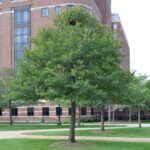
Tree Nyssa sylvatica 'David Odom' [sold as Afterburner® Tupelo] [Afterburner® Tupelo] Female trees must have a male pollinator to set fruit, difficult to transplant due to taproot.
Tree Nyssa sylvatica 'Hayman Red' [sold as Red Rage®] [Red Rage Black Gum] 'Haymanred', the broadly pyramidal cultivar of the Indiana native Black Gum, is know for its rich and vibrant fall color, lustrous dark green leaves and resistance to leaf spot. Selected from southern Indiana and introduced by Mike Hayman, it is one of the best cultivars of black gum. Can be difficult to transplant due to its taproot, use container-grown plants or plants dug with a soil ball. Can be used in areas with wet soils.
Tree Nyssa sylvatica 'WFH1' [sold as Tupelo Tower™] [Tupelo Tower Black Gum] Tupelo Tower is one of the only upright, of columnar habit, unlike the straight species. Its tight habit, brilliant fall color, and urban tolerances make this cultivar highly saught after. Typically, a slightly acidic soil is needed for this species to perform well. Difficult to transplant, so best purchase as container grown. Wet soils tolerant.
Tree Indiana Native Audio Recording Available Nyssa sylvatica 'Wildfire' [Wildfire Blackgum] Especially useful in wet soils. One of the most beautiful trees, with habit comparable to Quercus palustris, but usually more irregular, and with a greater number of more slender main limbs. Silvery-grey, picturesque branching; strong horizontal accent. Difficult to transplant due to taproot; use container-grown plants when possible, or at least plants dug with a soil ball. Shelter from wind. In the North, select native northern stock as the species has a wide geographic range.… Indiana NativeAudio Recording Available