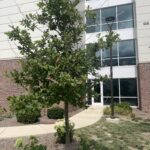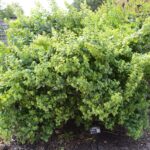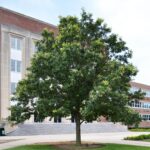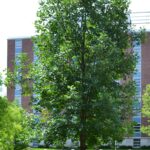
Shrub Purdue Plant Doctor Available Philadelphus × 'Miniature Snowflake' [Mock Orange Miniature Snowflake] Purdue Plant Doctor Available
Tree Indiana Native Audio Recording AvailableID That Tree Video AvailablePurdue Plant Doctor Available Populus balsamifera [Balsam Poplar] Buds exude a resin (the source of "balm of Gilead") that is traditionally used as an ointment to relieve chest congestion. The resin is also flammable, so twigs are used for starting fires. The streaked brown and grey wood is used in carving and woodworking. Trees are found along forest edges, forests, meadows and fields, and shores of rivers or lakes. Indiana NativeAudio Recording AvailableID That Tree Video AvailablePurdue Plant Doctor Available
Tree Indiana Native Audio Recording AvailableID That Tree Video AvailablePurdue Plant Doctor Available Quercus bicolor [Swamp White Oak] The Swamp White Oak is a sturdy, long-lived tree that is generally tolerant to average conditions and even wet soil, but requires full sun and acidic soil. Indiana NativeAudio Recording AvailableID That Tree Video AvailablePurdue Plant Doctor Available
Tree Indiana Native Audio Recording AvailableID That Tree Video AvailablePurdue Plant Doctor Available Quercus lyrata [Overcup Oak] The Overcup Oak is a medium-sized oak with an oval crown and lower branches that sweep upward. This species thrives in lowlands and bottomlands and can tolerate extended flooding. The common name is derived from its acorn, which can be nearly 3/4 "cupped" by the cap. Acorns generally aren't produced until the tree is around 25-30 years old. Indiana NativeAudio Recording AvailableID That Tree Video AvailablePurdue Plant Doctor Available
Tree Indiana Native Audio Recording AvailablePurdue Plant Doctor Available Quercus michauxii [Swamp Chestnut Oak] Similar to Quercus montana but obtains a larger ultimate size and is found in moister soils. Common in low areas, river bottoms, swamp borders and ravines. It gained its common name of "Basket Oak" from the baskets created from its wood, and the common name "Cow Oak" from the sweet, edible acorns relished by cows. Indiana NativeAudio Recording AvailablePurdue Plant Doctor Available
Tree Purdue Plant Doctor Available Quercus nuttallii [Nuttall Oak] New growth is reddish purple with red fall color. A fast grower that prefers zones 7, 8, and 9. Purdue Plant Doctor Available
Tree Indiana Native Audio Recording AvailableID That Tree Video AvailablePurdue Plant Doctor Available Quercus palustris [Pin Oak] Handsome tree, distinctive for its regular branching, spreading to horizontal to pendulous, from top to bottom of the tree. This effect is partly lost when lower limbs must be removed for traffic underneath. Requires an acidic soil and is subject to severe iron chlorosis on calcareous soils. This can be corrected but it means additional maintenance. Indiana NativeAudio Recording AvailableID That Tree Video AvailablePurdue Plant Doctor Available
Tree Audio Recording AvailablePurdue Plant Doctor Available Quercus palustris 'Crownright' [Crownright Pin Oak] Handsome tree with a more upright habit that lacks the pendulous character of the lower branches seen in the species type. Requires an acidic soil and is subject to severe iron chlorosis on calcareous soils. This can be corrected but it means additional maintenance. Audio Recording AvailablePurdue Plant Doctor Available
Tree Purdue Plant Doctor Available Quercus palustris 'Pringreen' [sold as Green Pillar®] [Green Pillar Pin Oak] This cultivar is a columnar habit, great for those smaller spaces. Its fall color is a vibrant red, which leads many to believe that the Scarlet Oak, (Quercus cocinea) is in the genetics of this cultivar. Green Pillar Pin Oak is grafted onto root stock, so graft incompatibility may be an issue in the future. Requires an acidic soil and is subject to severe iron chlorosis on calcareous soils. This can be corrected but it… Purdue Plant Doctor Available
Tree Indiana Native Audio Recording AvailablePurdue Plant Doctor Available Quercus phellos [Willow Oak] Somewhat tolerant of city conditions. Oak wilt and scales, and many other oak tree pests, though none considered very serious. Low maintenance, long-lived tree. Use Northern sources in Indiana. Indiana NativeAudio Recording AvailablePurdue Plant Doctor Available