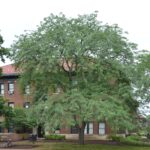
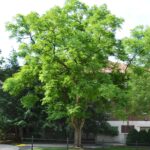
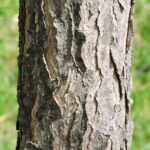
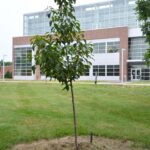
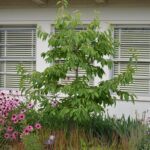
Tree Halesia carolina [Carolina Silverbell] This small tree is interesting in bloom and rather neutral otherwise, but relatively trouble free and useful in many situations as a neutral background plant, or for its flowers. Best grown as a single stem and allowed to branch low (20-30"). Does not transplant well (a particular problem with field-grown plants).
Tree Halesia carolina 'Arnold Pink' [Pink Carolina Silverbell] This small tree is interesting when in bloom with pink bell-shaped flowers that are larger than the straight species, but this plant is rather neutral otherwise. However, it is relatively trouble free and useful in many situations as a neutral background plant, or for its flowers. Best grown as a single stem and allowed to branch low (20-30"). Does not transplant well (a particular problem with field-grown plants).
Tree Halesia carolina 'Rosea' [Pink Mountain Silverbell] The Pink Mountain Silverbell is interesting in bloom (pale pink flowers), rather neutral otherwise, but relatively trouble free and useful in many situations as a neutral background plant, or for its flowers. Flowers and fruits are larger than the related species H. carolina. Best grown as a single stem and allowed to branch low (20-30"). Does not transplant well (a particular problem with field-grown plants).
Tree Heptacodium miconioides [Seven-son Flower] The common name, Seven-Son Flower, is derived from the cluster of 7 small flowers contained within each whorl. The flowers are followed by very showy, reddish fruit structures that have the appearance of flowers. The tan, shredding bark is attractive and exfoliates in long strips to reveal a dark brown inner bark. This plant can be hard to find, both in the wild and in commerce. Needs pruning to maintain aesthetics.
Tree Indiana Native Ilex opaca [American Holly] This species, like other hollies, is dioecious, so plant females for fruit and an occasional male for pollination. Winter desiccation injury can occur on leaves in exposed sites. Holly leaf miners are one of the major pest problems for Ilex opaca.
Tree Ilex opaca 'Old Heavy Berry' [Old Heavy Berry American Holly] 'Old Heavy Berry' is an excellent, vigorous female cultivar with good winter hardiness and an abundance of large, bright red fruits. This species, like other hollies, is dioecious, so plant females for fruit and an occasional male for pollination. Winter desiccation injury can occur on leaves in exposed sites. Holly leaf miners are one of the major pest problems for Ilex opaca.
Tree Indiana Native Juglans cinerea [Butternut] Juglans cinera is a large, rounded tree similar to, but overall smaller than the Black Walnut (Juglans nigra). It is not commonly grown for ornamental purposes. The nut, once one is able to crack the hard shell, is edible, sweet, oily, and buttery. Long tap root makes transplanting difficult. This species is valued for its wood and between overharvesting and losses from Butternut Canker (Sirococcus clavigignenti-juglandacearum), this species has become rare in its native habitat.
Tree Indiana Native Juglans nigra [Black Walnut] Nuts are a serious litter problem, staining sidewalks and driveways. Juglone (found in leaf litter and possibly roots) is toxic to many plants, like tomatoes, blackberries, red pines, and many others. Black Walnut wood is valuable and has a variety of commercial uses, especially for furniture.
Tree Juglans regia [Persian Walnut] Juglans regia is a large, rounded, spreading tree that produces the walnuts frequently seen in stores. It may take up to 20 years for this tree to become mature enough to produce a decent-sized crop of nuts. Long tap root makes transplanting difficult.
Tree Juniperus chinensis 'Mountbatten' [Mountbatten Chinese Juniper] 'Mountbatten' is a hardy, dense, and narrow cultivar with silver-green needles. Widely adaptable to soils and climates. Tolerates alkaline soils, heat, and drought. Members of this species are used from New England to Minnesota to Louisiana. Phomopsis and Kabatina blights can be a serious problem in some areas, especially for small plants.