Glossary: Leaf morphology

Purdue Arboretum botanical terminology reference and learning database.

368 Botanical Definitions 10 Categories A–Z Alphabetical Index Illustrated Growth Forms
Active Category Filter

Leaf morphology

← View All Categories
🌳

Illustrated Growth Forms & Tree Silhouettes

Compare visual architectures: fastigiate, columnar, weeping, spreading, and more.

Fastigiate Columnar Pendulous / Weeping
Try searching:
Showing 30 definitions
Synonyms: Bipinnate, Bipinnates, Pinnatelies, Pinnately, Pinnates, Pinnatifid, Pinnatifids, Pinnatipartite, Pinnatipartites, Pinnatisect, Pinnatisects

Pinnate Having parts arranged like a feather, symmetrically on either side of a central rib - often used to describe compound leaves. Did you know? Ash, walnut, hickory, and rose leaves are pinnate, with leaflets arranged along a central stalk.
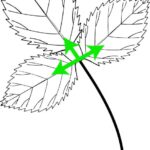
Synonyms: Biserrate, Biserrates, saw toothed, saw-toothed, Serrates, Serrulate, Serrulates, toothed edge

Serrate With a saw-toothed edge. Botanists use this feature to describe leaf shape, surface, edge, or arrangement, which helps with plant identification.

Synonyms: Simples

Simple Not divided into leaflets. Botanists use this feature to describe leaf shape, surface, edge, or arrangement, which helps with plant identification.

Synonyms: Spathulate, spathulate, Spathulates, Spatulates

Spatulate Shaped like a spatula, with a rounded tapering blade. Botanists use this feature to describe leaf shape, surface, edge, or arrangement, which helps with plant identification.

Synonyms: Subcordates

Subcordate Almost heart-shaped or cordate. Botanists use this feature to describe leaf shape, surface, edge, or arrangement, which helps with plant identification.

Synonyms: Trifoliates

Trifoliate Having compound leaves composed of 3 leaflets. Botanists use this feature to describe leaf shape, surface, edge, or arrangement, which helps with plant identification.

Synonyms: Venations

Venation Pattern of veins. Botanists use this feature to describe leaf shape, surface, edge, or arrangement, which helps with plant identification. Did you know? Leaf venation patterns help separate monocots, which often have parallel veins, from dicots, which usually have branching veins.

The Purdue Arboretum is a collaboration between the Department of Horticulture and Landscape Architecture and Administrative Operations

Purdue Arboretum, 625 Agriculture Mall Dr, West Lafayette, IN, 47907
© 2026 Purdue UniversityAn equal access/equal opportunity universityCopyright ComplaintsMaintained by Purdue Arboretum Explorer
Contact Purdue Arboretum at arboretum@purdue.edu for accessibility issues with this page | Accessibility Resources | Contact Us