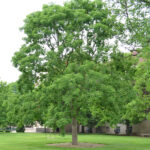
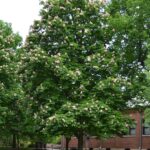
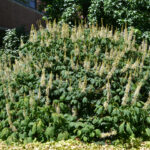
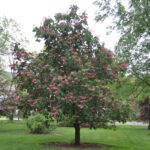
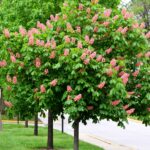
Tree Aesculus × carnea [Red Horsechestnut] More drought resistant and more resistant to blotch and mildew than A. hippocastanum. Comes true to type from seed. Flowers at early age. Does not perform well in dry sites. Prickly fruits may be a problem underfoot. Fruits are poisonous (containing toxic saponins). Often develops branches having narrow crotch angles (branches that should be removed).
Tree Aesculus × carnea 'Fort McNair' [Fort McNair Red Horsechestnut] Fort McNair Red Horsechestnut is less suscebtible to leaf scorch, leaf blotch and mildew than the straight species, although it can still contract the diseases. Does not perform well in dry sites; plant in moister soils for best growth and flowering. Flowers at an early age. Prickly fruits may be a problem underfoot. Fruits are poisonous (containing toxic saponins). Often develops branches having narrow crotch angles (branches that should be removed).
Tree InvasiveThis plant is considered invasive Ailanthus altissima [Tree of Heaven] Unusual form and texture not unlike a large sumac. Highly adaptable. Tolerates salt spray. Dioecious. Coarse and inclined to drop twigs. Male flowers are malodorous; female plants make many weed seedlings. Ailanthus altissima forms dense, clonal thickets which displace native species and can rapidly invade fields, meadows, and harvested forests. This invasive tree species is extremely tolerant of poor soil conditions and can even grow in cement cracks. Ailanthus altissima is not shade tolerant, but…
Tree Indiana Native Amelanchier arborea [Downy Serviceberry] Would grow well on a streambank. Susceptible to rust, leaf blight, powdery mildew, fruit rot, leaf minor, borers, and scale. Rarely requires pruning.
Shrub/Tree Indiana Native Amelanchier canadensis [Shadblow Serviceberry] Amelanchier canadensis, the Shadblow Serviceberry, tends to be confused with Amelanchier arborea, the Downy Serviceberry, and Amelanchier laevis, the Allegheny Serviceberry. However, A. canadensis, compared to A. arborea and A. laevis, is generally much more shrub-like (often forming thickets), flowers a week later, and produces upright flower clusters (as opposed to the pendulous racemes of A. arborea and A. laevis). The Shadblow Serviceberry is excellent for woodland plantings, naturalizing, and along stream and pond banks.…
Shrub/Tree Indiana Native Amelanchier canadensis 'Sprizam' [sold as Spring Glory®] [Spring Glory Shadblow Serviceberry] A new variety, notable for its compact, upright habit reaching only 12' tall and 8-10' wide.
Tree Indiana Native Amelanchier laevis [Allegheny Serviceberry] An excellent small tree for naturalizing and for very early, but short-lived, bloom. Fruits are edible and a prime source of food for birds. Can produce fruit by apomixis. Subject to the troubles of Rosaceous plants in general, including fire-blight and mites, which can be controlled, usually quite easily.
Tree Amelanchier × grandiflora 'Autumn Brilliance' [sold as Autumn Brilliance®] [Autumn Brilliance Apple Serviceberry] A. x grandiflora 'Autumn Brilliance is a vigorous selection with impressive blooms and bright red fall colors. It is resistant to leaf spot. The berries are frequently used to make jams, jellies, and pies. This selection can be found in both single and multi-trunk forms.
Shrub Indiana Native Amorpha fruticosa [Indigobush Amorpha] The Indigobush Amorpha is a Indiana native shrub that can be found along river banks and shallow marshes. This shrub can be planted in areas of poor soil where few other plants will survive, as well as used for erosion control. To avoid weediness, seeds can be collected shortly after flowering as it can spread readily by seeds. Common problems of Amorpha fruticosa includes rust, leaf spots, powdery mildew and twig canker. Some gall problems…
Liana (Climbing Vine) InvasiveThis plant is considered invasive Ampelopsis glandulosa var. heterophylla [Porcelain Ampelopsis] Best fruiting in full sun. Restricting root growth can enhance fruit production. Japanese beetles love them. Can be invasive. Rampant growth.