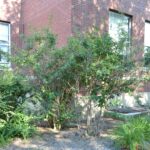
Shrub Symphoricarpos × chenaultii [Chenault Coralberry] A more refined plant than the parent S. orbiculatus, perhaps more showy in flower and fruit and more useful in the shrub border. Useful as a bank cover or large scale groundcover. Transplants well. This plant has a beautiful fruit show and is shade tolerant, however, it is also a twiggy, "garbage can plant" (collects leaves and blowing debris); this quality (especially prominent in the fall and winter) limits its usability in the landscape.
Tree Syringa reticulata [Japanese Tree Lilac] A very hardy and showy tree. Attractive, cherry-like mahogany-colored bark, distinctly different from all other lilacs. Widely adapted to soils and environments. Cut to ground to rejuvenate completely. Mildew resistant. Subject to infestations of borers and scale insects, but these are not usually serious enough to discourage its use where some maintenance is available. Alternate year flowering on different parts of the tree can sometimes occur, a problem that can be assuaged by deadheading (use…
Tree Indiana Native Taxodium distichum [Common Baldcypress] Nice planted in groupings around water. Develops cypress knees (possibly for gas exchange), but generally only near water.
Tree Taxodium distichum 'Michelson' [sold as Shawnee Brave®] [Shawnee Brave Baldcypress] Nice planted in groupings around water. Develops cypress knees (possibly for gas exchange), but generally only near water. Mite resistant foliage.
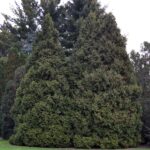
Tree Indiana Native Thuja occidentalis [Eastern Arborvitae] One of the best plants for screening in moist, well-aerated soils. Bagworms can be a problem. Subject to several other insect pests, all of which usually can be controlled with timely spraying. Deer may feed on foliage. Winter color can be poor.
Tree Thuja plicata 'Elegantissima' [Elegant Giant Arborvitae] One of the best plants for screening when grown in wet, but not saturated soils. An important timber tree in the western US. Subject to several pests (especially bagworms), all of which usually can be controlled with timely spraying.
Tree Tilia americana 'Redmond' [Redmond American Linden] Very adaptable, even in alkaline soil, but does not tolerate much air pollution. Too big for most urban landscapes. Japanese beetles like feeding on it.
Tree Tilia cordata 'Greenspire' [sold as Greenspire®] [Greenspire Littleleaf Linden] Pollution tolerant and adaptable to city conditions. A great choice as a street or shade tree with its dense form and strong central leader. Can have issues with Japanese beetles in mid-summer.