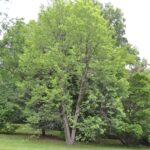
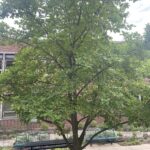
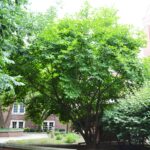
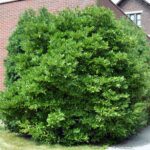
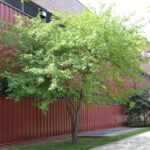
Tree Indiana Native Magnolia acuminata [Cucumbertree Magnolia] This tree gets it name from the cucumber-looking fruits it bears in the fall. Full sun is best, although it has tolerance for partial shade. Because the roots are thick and fleshy and grow downward more than out, it can be moderately difficult to transplant. Generally trouble-free, but scale can be a problem on occasion. This species may not be ideal for street tree plantings because of a tendency to suffer ice damage.
Tree Magnolia × loebneri 'Encore' [Encore Loebner Magnolia] Encore Loebner Magnolia has a more rounded, compact habit than the hybrid Magnolia x loebneri, reaching 10-12' in height. This cutlivar has anywhere from 18 to 25 tepals that are pink-tinged at the base. Plant in a protected location to prevent spring frosts from damaging the flowers.
Tree Magnolia × soulangeana [Saucer Magnolia] Many of the showiest magnolia cultivars belong to this species. One of the most common flowering trees in the Midwest, it is apparently well-adapted. Its very early spring flowers can be killed by late frost; they turn brown and limp. Can be troubled by magnolia scale, but this can be kept under control by timely spraying. Fleshy roots with few laterals. Does not transplant well so best to buy container grown plants.
Shrub/Tree Magnolia stellata [Star Magnolia] Handsome specimen at all seasons. Needs at least some protection from strong wind in Zones 4 and 5. Somewhat prone to breakage in severe ice storms. Early blooming flowers often destroyed by late spring frosts.
Tree Indiana Native Magnolia tripetala [Umbrella Magnolia] Full sun or light partial shade. Tropical appearance. Flowers are creamy white with an unpleasant smell. The cone-like rosy red fruit matures in September-October. Endangered in Indiana. Large leaves can be injured by hail or wind. Perhaps too coarse for most landscape situations.
Shrub/Tree Magnolia virginiana [Sweetbay Magnolia] Nice flower fragrance, but never overwhelming. Does well in wet soils, unlike other magnolias. Requires acid soil, some moisture, and tolerates some shade. Chlorosis can sometimes be a problem, especially prevalent on alkaline soils.
Tree Malus × 'Adirondack' [Adirondack Flowering Crabapple] The Flowering Crabapple is a popular small ornamental tree with an extremely showy flower display in the spring. This variant has a vase-shaped (somewhat columnar) habit, extremely upright branching, and high resistance to apple scab, fireblight, cedar-apple rust, and powdery mildew. Tends to flower and fruit in alternate years. Well-drained heavy loam soils and full sun promote best growth.
Tree Malus × 'Indian Magic' [Indian Magic Flowering Crabapple] The Flowering Crabapple is a popular small ornamental tree with an extremely showy flower display in the spring. 'Indian Magic' is not as disease resistant as others, being moderately susceptible to scab. Tends to flower and fruit in alternate years. Well-drained heavy loam soils and full sun promote best growth. Can be susceptible to many pests and diseases, including apple scab, fireblight, Japanese beetles, leaf spot, cedar-apple rust, and powdery mildew. May look ragged at…
Tree Malus sargentii [Sargent Crabapple] The smallest of all Malus species, almost a shrub. Strongly horizontal branching. Tends to be apomictic (seeds develop without fertilization), so is usually very uniform from seed (i.e. clonal). Sometimes flowers and fruits in alternate years. Susceptible to apple scab disease. May require pruning of wayward and crossing branches to maintain a nice form.
Tree Malus × 'Snowdrift' [Snowdrift Flowering Crabapple] The Flowering Crabapple is a popular small ornamental tree with an extremely showy flower display in the spring. 'Snowdrift' is a vigorous selection that is covered with numerous white blossoms in the spring, which are then followed by attractive orange-red crabapple fruits. Susceptible to apple scab and fire blight. Well-drained heavy loam soils and full sun promote best growth. May look ragged by the end of the summer.