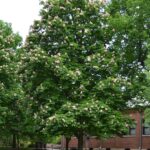
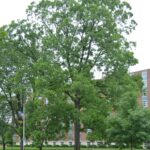
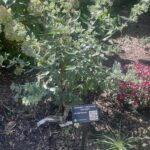
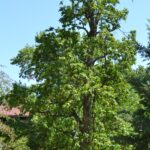
Tree Aesculus hippocastanum [Common Horsechestnut] Widely adapted to soils and environments; however, very dry conditions must be avoided. Leaf blotch often disfigures foliage. Spiny fruits in autumn can be troublesome underfoot, and eliminates species type as a good street tree. Fruits are toxic containing 3-5% saponins.
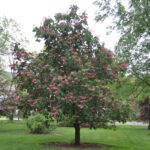
Tree Aesculus × carnea [Red Horsechestnut] More drought resistant and more resistant to blotch and mildew than A. hippocastanum. Comes true to type from seed. Flowers at early age. Does not perform well in dry sites. Prickly fruits may be a problem underfoot. Fruits are poisonous (containing toxic saponins). Often develops branches having narrow crotch angles (branches that should be removed).
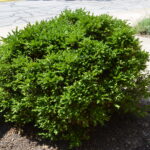
Shrub Buxus 'Green Gem' [Green Gem Boxwood] This species is a hybrid of Buxus sinica and Buxus sempervirens and is described as a perfect round ball. Hardier than var. insularis 'Winter Beauty'. Requires little prunning and shearing. Avoid cultivating around plants because they have a shallow root. Roots appreciate a good mulch ( 1-2"). Thin plants and remove damaged branches annually to improve air circulation. Buxus X 'Green Gem' is best suited to a sheltered lacation which protects it in the winter…
Tree Indiana Native Carya illinoinensis [Pecan] The Pecan is a tall, straight-trunked tree and is the largest of the hickories. It is well-known for its sweet, edible nuts and because of this, it is an important horticultural crop in the south, where it produces fruit most abundantly. However, it is not generally recommended for use in the landscape, due to its pest susceptibility and litter problem. With its large taproot, it can also be quite difficult to transplant.
Tree Indiana Native Catalpa speciosa [Northern Catalpa] Coarse winter trunks and branches are bold and striking; picturesque. Best for difficult areas. Wood is rot resistant, but is somewhat brittle so branches can fall in wind and ice storms. Too coarse of texture for most urban landscapes. Short-lived to about 50 years.
Shrub Indiana Native Cornus amomum [Silky Dogwood] Easy to transplant. Relatively trouble-free. A three-year pruning cycle improves form, vigor, and winter stem color effect. Cutting all stems 6-12" from ground in late winter has similar effect. Best in mass plantings. Excellent for winter color. Scale and leaf spot can be a problem. Can appear a bit coarse in the landscape.
Tree Indiana Native Cornus florida [Flowering Dogwood] One of the finest small trees, interesting at almost every season. Distinct horizontal branching patterns. Widely adaptable, but material of different geographic origin varies widely in hardiness. Fruit is an important food supply for native birds and other animals. Not extremely drought-tolerant, but useful in most parts of the Midwest. Dogwood borer and dogwood anthracnose (caused by Discula destructiva) can be problematic, especially in the Eastern and Southern US. Difficult to transplant. Not pollution tolerant.…