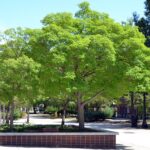
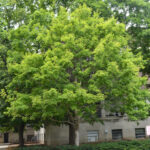
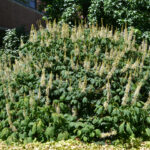
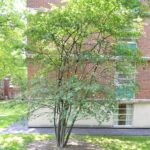
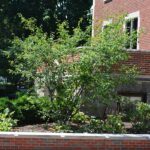
Tree Acer triflorum [Three-Flower Maple] Acer triflorum tends to be an understory tree in its natural habitat. Its beautiful exfoliating bark reveals a rusty brown coloration, providing attractive winter interest. Its shallow root system cannot handle drought well, unless properly mulched. This maple can handle full shade but is best in part shade to full sun.
Tree Acer × freemanii 'Armstrong' [Armstrong Red Maple] The Armstrong Red Maple is a cross between Acer rubrum and Acer saccharinum and is known for its columnar habit and brilliant red to red-orange fall coloration. This species has the durability of the Silver Maple and can tolerate urban conditions. The root system is less aggressive, though, so it can be planted as a street tree.
Tree Acer × freemanii 'Celzam' [sold as Celebration®] [Celebration Freeman Maple] 'Celzam' has a classic upright form with uniform growth, making for a great specimen tree in the landscape. This plant, like most Freeman hybrids, is generally seedless and is also known for its fall color. In early October, 'Celzam' becomes a brilliant red and then slowly changes to gold by late October.
Tree Acer × freemanii 'Jeffersred' [sold as Autumn Blaze®] [Autumn Blaze Maple] This cultivar is among the best for fall foliage of both Red and hybrid Red Maples. It is an extremely fast grower and appears to be more drought tolerant than most Acer rubrum cultivars. 'Jeffersred', is often sold under the tradmark name, Autumn Blaze.
Tree Acer × freemanii 'Scarsen' [sold as Scarlet Sentinel®] [Scarlet Sentinel Freeman Maple] This cultivar is a cross between the Red Maple and the Silver Maple, though it's leaves and bark more closely resemble the Silver Maple. It is one of the most adapted maples for southern regions of the country. 'Scarsen' is known for its colorful yellow-orange to orange-red fall foliage and columnar growth form.
Shrub Indiana Native Aesculus parviflora [Bottlebrush Buckeye] Can be kept at a smaller size for a time with careful pruning, but it will in time occupy much space. Tolerates some shade, and can even be attractive under large shade trees. Suckers quite freely.
Tree Indiana Native Amelanchier arborea [Downy Serviceberry] Would grow well on a streambank. Susceptible to rust, leaf blight, powdery mildew, fruit rot, leaf minor, borers, and scale. Rarely requires pruning.
Shrub/Tree Indiana Native Amelanchier canadensis [Shadblow Serviceberry] Amelanchier canadensis, the Shadblow Serviceberry, tends to be confused with Amelanchier arborea, the Downy Serviceberry, and Amelanchier laevis, the Allegheny Serviceberry. However, A. canadensis, compared to A. arborea and A. laevis, is generally much more shrub-like (often forming thickets), flowers a week later, and produces upright flower clusters (as opposed to the pendulous racemes of A. arborea and A. laevis). The Shadblow Serviceberry is excellent for woodland plantings, naturalizing, and along stream and pond banks.…
Shrub/Tree Amelanchier canadensis 'Glenn Form' [sold as Rainbow Pillar®] [Rainbow Pillar Shadblow Serviceberry] This cultivar of the Shadblow Serviceberry is known for its bright, multi-colored fall foliage that can be a combination of reds, oranges, and yellows. Spectacular, yet short lived, white flowers bloom in early spring. Given its upright, dense habit, it is best used as a screen or hedge. Mildew resistant.
Shrub/Tree Indiana Native Amelanchier canadensis 'Sprizam' [sold as Spring Glory®] [Spring Glory Shadblow Serviceberry] A new variety, notable for its compact, upright habit reaching only 12' tall and 8-10' wide.