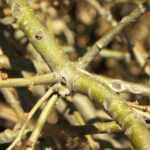
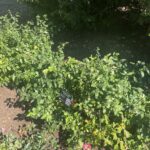
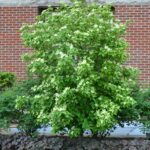
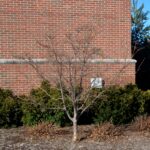
Shrub Chaenomeles speciosa 'Cameo' [Cameo Flowering Quince] 'Cameo' is known for its abundant beautiful, double, peach-pink flowers in April. The flowers are born on old wood just before the leaves fully emerge, and occur singly or 2-4 per cluster, creating an excellent dispersal of coloring throughout the shrub. Unlike the straight species, the bright, lustrous foliage of 'Cameo' provides seasonal interest after the one week of flower show, making it a more useful flowering quince. Sparsely produces small, apple-like fruits, commonly called…
Shrub Chaenomeles speciosa 'Rubra' [Red Flowering Quince] Strongly red single flowers occur in late April are born on old wood just before the leaves fully emerge, and occur singly or 2-4 per cluster, creating an excellent dispersal of coloring throughout the shrub. Sparsely produces small, apple-like fruits, commonly called quinces, that are edible if used in preserves; harvest in October. Widely adapted to different soils and microclimates. Place in full sun location for best flower display, although it is tolerant to partial…
Shrub Chaenomeles × superba 'Crimson and Gold' [Crimson and Gold Flowering Quince] The Crimson and Gold Quince offers season-round interest. Also the Quince plant produces edit Pear-shaped fruit that is bitter right off the stem but can be used in sweet fall recipes. The Crimson and Gold cultivar shows of it's color with bright red flowers that bloom in Spring. In winter the fruits hold on to the thorny stems after the plant loses it's foliage.
Tree Cornus kousa [Kousa Dogwood] A striking specimen tree flowering later than the Flowering Dogwood (Cornus florida) and differing in having pointed bracts. Variable in bract size and shape, and in habit. Better adapted in cultivation than C. florida in much of the Midwest. For best flowering, place in full sun. Quite resistant to anthracnose. Needs watering during severe droughts. Can get borers but less susceptible to them than C. florida.
Tree Cornus kousa 'Satomi' [Pink Kousa Dogwood] A striking specimen tree flowering later than the Flowering Dogwood (Cornus florida) and differing in having pointed bracts. 'Satomi' is an upright cultivar known for its strong horizontal branching and rose-pink bracts, which vary in intensity, depending on environmental and cultural conditions. For best flowering, place in full sun. Better adapted in cultivation than C. florida in much of the Midwest. Quite resistant to anthracnose. Needs watering during severe droughts. Can get borers but less…
Tree Cornus kousa var. chinensis [Chinese Kousa Dogwood] A striking specimen tree flowering later than the Flowering Dogwood (Cornus florida) and differing in having pointed bracts. The variety chinesis has larger flower bracts (up to 2.5" long) than the straight species. Better adapted in cultivation than C. florida in much of the Midwest. For best flowering, place in full sun. Quite resistant to anthracnose. Needs watering during severe droughts. Can get borers but less susceptible to them than C. florida.
Tree Cornus kousa var. chinensis 'Milky Way' [Milky Way Chinese Kousa Dogwood] A striking specimen tree flowering later than the Flowering Dogwood (Cornus florida) and differing in having pointed bracts. The variety chinesis has larger flower bracts (up to 2.5" long) than the straight species, and 'Milky Way' has an especially abundant flower and fruit set. Better adapted in cultivation than C. florida in much of the Midwest. For best flowering, place in full sun. Quite resistant to anthracnose. Needs watering during severe droughts. Can get borers…
Shrub Indiana Native Corylus americana [American Hazelnut] The American Hazelnut is a medium to fast growing shrub and an Indiana native. Being monoecious, the male catkins are 1 1/2 to 3" long, that emerge yellowish brown and are quite showy in early spring. The female catkins are inconspicuous with its stigma and style barely protruding out of the buds, but the color is a rich red. The American Hazelnut is a great large shrub for native restoration projects or adding seasonal interest…
Shrub Corylus avellana [European Filbert] Corylus avellana is a tough, usually a large, suckering, thicket-forming shrub, but it can also be grown as a small tree, if the suckers are controlled. The nut is edible and Corylus avellana is frequently grown for production in Europe.
Tree Corylus colurna [Turkish Filbert] Horizontal branch structure (with lower branches often touching the ground), strong central leader, and bark give good winter character. Does great in hot summers and cold winters, very adaptable. Quite drought tolerant after establishment, leaves stay green when maples scorch. Needs supplemental water immediately after transplanting and until established. Otherwise drought tolerant. Nuts are edible and can be roasted.