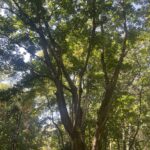
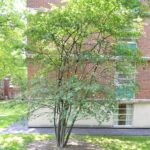
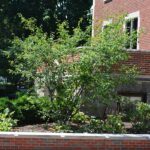
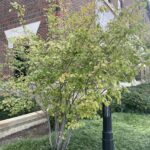
Tree Purdue Plant Doctor Available Acer pictum ssp. mono [Painted Maple] This tree will sometimes be seen growing in a shrub-like habit. A milky sap comes out of the stem when it is cut. Smooth gray bark with longitudinal fissures in an irregular pattern resembles the bark of Acer palmatum, the Japanese Maple. Purdue Plant Doctor Available
Tree Purdue Plant Doctor Available Acer tataricum ‘Garann’ [sold as Hot Wings® Tatarian Maple] [Hot Wings Tatarian Maple] The cultivar name comes from the scarlet red winged fruits that appear on this tree in mid to late summer. Purdue Plant Doctor Available
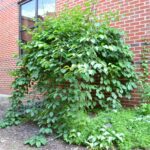
Liana (Climbing Vine) Audio Recording Available Actinidia arguta [Bower Actinidia] Requires a strong support. Dioecious. Flesh, seed, and fuzzless skin of fruit is edible, and has high vitamin C content. Rampant growth needs pruning. Japanese beetles have some attraction to the foliage. Audio Recording Available
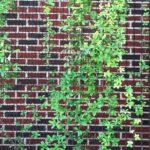
Liana (Climbing Vine) Akebia quinata [Fiveleaf Akebia] Fiveleaf Akebia is a vigorous vine that establishes quickly under many different conditions, even to the point of invading an area. Prune to keep this plant within its boundaries. Best used to climb up structures, but can also be used as a sprawling groundcover. Although generally deciduous, Akebia quinata can be evergreen in the south.
Tree Indiana Native Audio Recording AvailableID That Tree Video AvailablePurdue Plant Doctor Available Amelanchier arborea [Downy Serviceberry] Would grow well on a streambank. Susceptible to rust, leaf blight, powdery mildew, fruit rot, leaf minor, borers, and scale. Rarely requires pruning. Indiana NativeAudio Recording AvailableID That Tree Video AvailablePurdue Plant Doctor Available
Shrub/Tree Indiana Native Audio Recording AvailablePurdue Plant Doctor Available Amelanchier canadensis [Shadblow Serviceberry] Amelanchier canadensis, the Shadblow Serviceberry, tends to be confused with Amelanchier arborea, the Downy Serviceberry, and Amelanchier laevis, the Allegheny Serviceberry. However, A. canadensis, compared to A. arborea and A. laevis, is generally much more shrub-like (often forming thickets), flowers a week later, and produces upright flower clusters (as opposed to the pendulous racemes of A. arborea and A. laevis). The Shadblow Serviceberry is excellent for woodland plantings, naturalizing, and along stream and pond banks.… Indiana NativeAudio Recording AvailablePurdue Plant Doctor Available
Shrub/Tree Purdue Plant Doctor Available Amelanchier canadensis 'Glenn Form' [sold as Rainbow Pillar®] [Rainbow Pillar Shadblow Serviceberry] This cultivar of the Shadblow Serviceberry is known for its bright, multi-colored fall foliage that can be a combination of reds, oranges, and yellows. Spectacular, yet short lived, white flowers bloom in early spring. Given its upright, dense habit, it is best used as a screen or hedge. Mildew resistant. Purdue Plant Doctor Available
Shrub/Tree Indiana Native Audio Recording AvailablePurdue Plant Doctor Available Amelanchier canadensis 'Sprizam' [sold as Spring Glory®] [Spring Glory Shadblow Serviceberry] A new variety, notable for its compact, upright habit reaching only 12' tall and 8-10' wide. Indiana NativeAudio Recording AvailablePurdue Plant Doctor Available
Shrub/Tree Purdue Plant Doctor Available Amelanchier × grandiflora 'Ballerina' [Ballerina Serviceberry] A. x grandiflora is a hybrid cross between A. arborea and A. laevis that typically has larger, slender and longer flowers than its parents. Ripe fruits are sweet and edible. Purdue Plant Doctor Available
Tree Purdue Plant Doctor Available Amelanchier × grandiflora 'Cole’s Select' [Cole's Select Apple Serviceberry] Cole's Select Apple Serviceberry is an attractive plant with multi-seasonal interest, thick, glossy foliage, and especially outstanding red to orange fall coloration. 'Cole's Select' tends to have slightly larger flowers and stronger spreading, more horizontal branching than the species type. The beautiful white clusters of flowers give rise to sweet purple-black berries that are edible by humans and especially relished by birds. The fruits can be used in pies, jams, and jellies. Purdue Plant Doctor Available