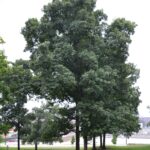
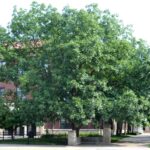
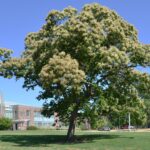
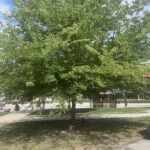
Tree Indiana Native Carya ovata [Shagbark Hickory] The bark of Carya ovata gives the tree its common name and is characteristically rough and shaggy on mature trees, growing in long flat plates, making especially good winter interest. The wood of this tree is especially hard, making it useful for a variety of products. This tree develops a large taproot, making it difficult to transplant.
Tree Indiana Native Carya tomentosa [Mockernut Hickory] This tree is found on ridges, dry hills, and slopes but grows best in moist, well-drained soil. The fall color is deep golden yellow to golden brown and persists. Fruit is round to elliptical with a thick husk splitting at the base and contains an edible seed.
Tree Carya × nussbaumeri [Hican] This tree is a hybrid of the pecan and shellbark hickory, thus the common name of "Hican". It was developed to produce a nut with the taste of pecans, but with the weaker shell of the shellbark hickory. This plant has a large tap root and can be difficult to transplant. Dropped fruits, stems, and leaves can be a litter problem. Can be prone to various fungal leaf spots.
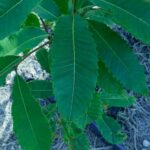
Tree Indiana Native Castanea dentata [American Chestnut] Highly susceptible to chesnut blight, causing this tree to be nearly extinct in the wild.
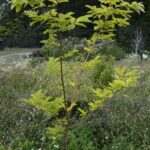
Tree Castanea dentata × mollissima [Dunstan Chestnut] Celebrated due to the quality of its fruit. Excellent nut quality that is attractive to deer and wildlife. Nuts drop in autumn, September-October. Often chosen as an orchard tree.
Tree Castanea mollissima [Chinese Chestnut] Overall tough and durable, but can be susceptible to blight, twig canker, and orient chestnut wasp. Also susceptible to weevils, which damages the roots. Prefers well-drained, loamy soils, full sun, and hot, arid conditions.
Tree Indiana Native Celtis laevigata [Sugar Hackberry] The Sugar Hackberry is very similar to the Common Hackberry (Celtis occidentalis) and is especially useful in large-scale situations with dry soils and heavy winds. This species gained its common name from the juicy, sweet berries it produces. Subject to a leaf nipple gall (caused by psyllid insect Pachypsylla dismamma, one of many jumping plant lice). However, the Sugar Hackberry is more resistant to witches'-broom disease (caused by Eriophyid mite) than the Common Hackberry. Especially…
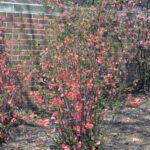
Shrub Chaenomeles japonica [Japanese Flowering Quince] Orange-red to scarlet flowers occur in early to mid-April and are born on one-year-old wood just before the leaves fully emerge, creating an excellent dispersal of coloring throughout the shrub. Sparsely produces small, apple-like fruits, commonly called quinces, that are edible if used in preserves; harvest in October. Widely adapted to different soils and microclimates. Place in full sun location for best flower display, although it is tolerant to partial shade. Subject to occasional scale…
Shrub Chaenomeles speciosa [Common Flowering Quince] White, pink, orange, salmon, or red single or double flowers (depending on variant) occur in late April, are born on old wood just before the leaves fully emerge, and occur singly or 2-4 per cluster, creating an excellent dispersal of coloring throughout the shrub. Sparsely produces small, apple-like fruits, commonly called quinces, that are edible if used in preserves; harvest in October. Widely adapted to different soils and microclimates. Place in full sun location for…
Shrub Chaenomeles speciosa 'Cameo' [Cameo Flowering Quince] 'Cameo' is known for its abundant beautiful, double, peach-pink flowers in April. The flowers are born on old wood just before the leaves fully emerge, and occur singly or 2-4 per cluster, creating an excellent dispersal of coloring throughout the shrub. Unlike the straight species, the bright, lustrous foliage of 'Cameo' provides seasonal interest after the one week of flower show, making it a more useful flowering quince. Sparsely produces small, apple-like fruits, commonly called…