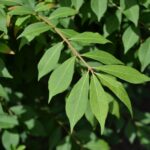
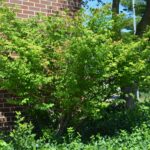
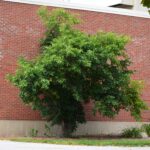
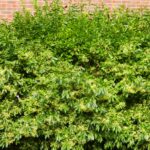
Shrub InvasiveThis plant is considered invasive Euonymus alatus [Winged Euonymus] Widely tolerant of most soil and microclimatic conditions, but develops good fall foliage color only when exposed to considerable direct sun. Tolerates heavy pruning. Can be troubled by scale insects, although not so frequently as the evergreen euonymus. Fruits are toxic. Avoid very dry or wet sites. Can be invasive, seeding into woodlots.
Shrub InvasiveThis plant is considered invasive Euonymus alatus 'Compactus' [Dwarf Winged Euonymus] The dense and lower-growing 'Compactus' is one of the most common Winged Euonymus cultivars. Widely tolerant of most soil and microclimatic conditions, but develops good fall foliage color only when exposed to considerable direct sun. Tolerates heavy pruning. Can be troubled by scale insects, although not so frequently as the evergreen euonymus. Fruits are toxic. Avoid very dry or wet sites. Can be invasive, seeding into woodlots.
Shrub/Tree Euonymus europaeus [Common Spindle Tree] Euonymus europaeus is an adaptable small tree (sometimes large shrub) that can spread and become invasive. The Common Spindle Tree's primary ornamental interest is its attractive and interesting fruits in the fall. Unfortunately, this tree can otherwise be quite unattractive, irregular, and spindley.
Shrub Euonymus kiautschovicus [Spreading Euonymus] Foliage fully evergreen in the South, but persists for only about half the winter in the North. Although not as serious as in other species of Euonymus, scale insects can be a problem. May be killed to ground in severe winters, but grows back rapidly.
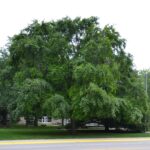
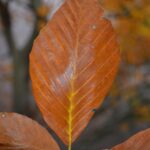
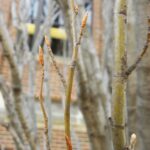
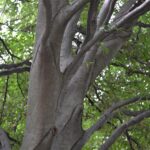
Tree Indiana Native Fagus grandifolia [American Beech] In a proper site, an excellent trouble-free shade tree with year-round interest. Less adaptable to hot, dry conditions than the exotic F. sylvatica, but somewhat more cold hardy. F. grandifolia is preferred in Zone 4. Like F. sylvatica, this tree is so shallow rooted and casts such heavy shade that grass does not grow well beneath it. Low branching habit is a concern for use in the tree lawn as a street tree (may require…
Tree Fagus sylvatica [European Beech] In a proper site, an excellent trouble-free shade tree with year-round interest. More adaptable to hot, dry conditions than our native F. grandifolia, but somewhat less hardy. F. grandifolia is preferred in Zone 4. Like F. grandifolia, this tree is so shallow rooted and casts such heavy shade that grass does not grow well beneath it. Low branching habit is a concern for use in the tree lawn as a street tree (may require more…
Tree Fagus sylvatica 'Dawyck' [Upright European Beech] In a proper site, an excellent trouble-free shade tree with year-round interest. More adaptable to hot, dry conditions than our native F. grandifolia, but somewhat less hardy. F. grandifolia is preferred in Zone 4. The cultivar 'Dawyck' is very strongly upright and columnar.
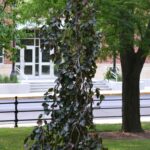
Tree Fagus sylvatica 'Purple Fountain' [Weeping Purple-Leaf European Beech] In a proper site, an excellent trouble-free shade tree with year-round interest. More adaptable to hot, dry conditions than our native F. grandifolia, but somewhat less hardy. F. grandifolia is preferred in Zone 4. 'Purple Fountain' is a somewhat columnar, yet weeping cultivar with long, pendulous braches. Foliage is attractive and emerges deep red-purple, generally fading to a bronzy purple-green by the end of the summer.
Tree Fagus sylvatica 'Purpurea Tricolor' [Tricolor Beech] Purple leaves are striped and edged with rose and pinkish white, more narrow leaves. In a proper site, an excellent trouble-free shade tree with year-round interest. More adaptable to hot, dry conditions than our native F. grandifolia, but somewhat less hardy. F. grandifolia is preferred in Zone 4. Like F. grandifolia, this tree is so shallow rooted and casts such heavy shade that grass does not grow well beneath it. Low branching habit is a…
Tree Fagus sylvatica var. heterophylla 'Asplenifolia' [Fern-Leaf European Beech] In a proper site, an excellent trouble-free shade tree with year-round interest. More adaptable to hot, dry conditions than our native F. grandifolia, but somewhat less hardy. F. grandifolia is preferred in Zone 4. Low branching habit is a concern for use in the tree lawn as a street tree (may require more pruning than other street trees). 'Asplenifolia' has attractive, fern-like leaves; the cultivar name was derived from the spleenwort fern genus, Asplenium.