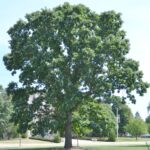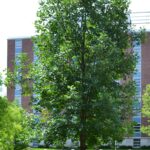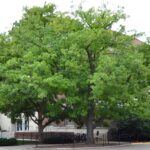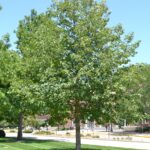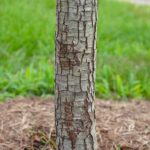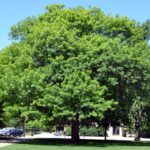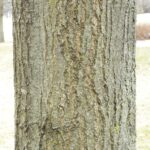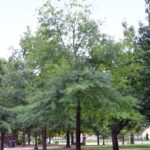
Tree Quercus macrocarpa 'JFS-KW3' [sold as Urban Pinnacle® Oak] [Urban Pinnacle Bur Oak] 'JFS-KW3' is a cultivar with smaller acorns that other bur oaks. It has glossy foliage that turns yellow in the fall and has disease resistance to both powdery mildew and anthracnose.
Tree Indiana Native Quercus michauxii [Swamp Chestnut Oak] Similar to Quercus montana but obtains a larger ultimate size and is found in moister soils. Common in low areas, river bottoms, swamp borders and ravines. It gained its common name of "Basket Oak" from the baskets created from its wood, and the common name "Cow Oak" from the sweet, edible acorns relished by cows.
Tree Indiana Native Quercus montana [Chestnut Oak] Naturally grows in rocky places and poor, dry sites. Dislikes poor drainage. Bark has the highest tannin content of any Quercus species.
Tree Indiana Native Quercus muehlenbergii [Chinquapin Oak] More tolerant of city conditions than most oaks.
Tree Indiana Native Quercus pagoda [Cherrybark Oak] Generally only hardy up to zone 6, this oak is larger than the closely related Southern Red Oak (Quercus falcata) and prefers wetter sites. It is native to southeastern regions of the United States and naturally grows as far north as southern Indiana and Illinois.
Tree Indiana Native Quercus palustris [Pin Oak] Handsome tree, distinctive for its regular branching, spreading to horizontal to pendulous, from top to bottom of the tree. This effect is partly lost when lower limbs must be removed for traffic underneath. Requires an acidic soil and is subject to severe iron chlorosis on calcareous soils. This can be corrected but it means additional maintenance.
Tree Quercus palustris 'Crownright' [Crownright Pin Oak] Handsome tree with a more upright habit that lacks the pendulous character of the lower branches seen in the species type. Requires an acidic soil and is subject to severe iron chlorosis on calcareous soils. This can be corrected but it means additional maintenance.
Tree Indiana Native Quercus phellos [Willow Oak] Somewhat tolerant of city conditions. Oak wilt and scales, and many other oak tree pests, though none considered very serious. Low maintenance, long-lived tree. Use Northern sources in Indiana.
Tree Quercus robur 'Fastigiata' [Columnar English Oak] The tightly columnar 'Fastigiata' provides a strong vertical accent, and is far more popular in the Midwest than the straight species. Powdery mildew on the leaves can be a significant problem. Seed propagated 80-90% true to type, thus variation can also be a problem.
Tree Indiana Native Quercus rubra [Northern Red Oak] One of the best and most reliable of oaks as a shade or street tree. More vigorous and fast-growing than most oaks. Good street tree since it performs reasonably well in small soil volumes (although it tends to branch close to ground). Oak wilt disease has been troublesome in certain areas of the Midwest. Hybridizes easily with other oaks (be careful of source).