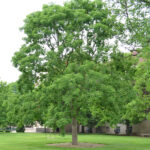
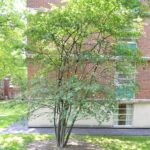
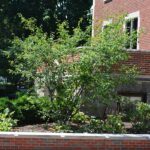
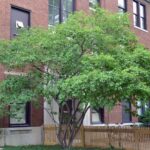
Tree Acer × freemanii 'Scarsen' [sold as Scarlet Sentinel®] [Scarlet Sentinel Freeman Maple] This cultivar is a cross between the Red Maple and the Silver Maple, though it's leaves and bark more closely resemble the Silver Maple. It is one of the most adapted maples for southern regions of the country. 'Scarsen' is known for its colorful yellow-orange to orange-red fall foliage and columnar growth form.
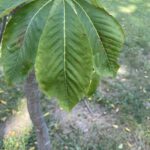
Tree Indiana Native Aesculus flava [Yellow Buckeye] The Yellow Buckeye is a large, majestic native tree that is widely adapted to soils and environments; however, very dry conditions must be avoided. Drought causes early leaf drop and leaf blotch, and leaf scorch can disfigure foliage in dry soil. That being said, this species is less prone to foliar problems than the related Aesculus glabra (Ohio Buckeye) is. Difficult to transplant once established due to long taproot. Large, abundant fruits in autumn can…
Tree Indiana Native Aesculus glabra [Ohio Buckeye] Widely adapted to soils and environments; however, very dry conditions must be avoided. Drought causes early leaf drop. Leaf blotch and leaf scorch often disfigure foliage, especially in dry soil. Spiny fruits in autumn can be troublesome underfoot, and eliminates species type as a good street tree. Fruits are toxic, containing 3-5% saponins.
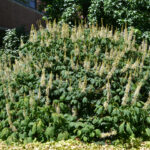
Shrub Indiana Native Aesculus parviflora [Bottlebrush Buckeye] Can be kept at a smaller size for a time with careful pruning, but it will in time occupy much space. Tolerates some shade, and can even be attractive under large shade trees. Suckers quite freely.
Shrub/Tree Aesculus pavia [Red Buckeye] The Red Buckeye can be a small tree or clump-forming, multi-stemmed shrub. The lustrous, deep green foliage is attractive, but tends to decline by August. Susceptible to leaf blotch, but less susceptible to mildew than Aesculus hippocastanum.
Shrub Alnus serrulata [Hazel Alder] Closely related to Alnus rugosa, differing chiefly in its leaves, which are usually broadest above the middle and have the margins set with fine, nearly regular teeth. Multi-stemmed habit and tends to sucker.
Tree Indiana Native Amelanchier arborea [Downy Serviceberry] Would grow well on a streambank. Susceptible to rust, leaf blight, powdery mildew, fruit rot, leaf minor, borers, and scale. Rarely requires pruning.
Shrub/Tree Indiana Native Amelanchier canadensis [Shadblow Serviceberry] Amelanchier canadensis, the Shadblow Serviceberry, tends to be confused with Amelanchier arborea, the Downy Serviceberry, and Amelanchier laevis, the Allegheny Serviceberry. However, A. canadensis, compared to A. arborea and A. laevis, is generally much more shrub-like (often forming thickets), flowers a week later, and produces upright flower clusters (as opposed to the pendulous racemes of A. arborea and A. laevis). The Shadblow Serviceberry is excellent for woodland plantings, naturalizing, and along stream and pond banks.…
Shrub/Tree Indiana Native Amelanchier canadensis 'Sprizam' [sold as Spring Glory®] [Spring Glory Shadblow Serviceberry] A new variety, notable for its compact, upright habit reaching only 12' tall and 8-10' wide.
Tree Indiana Native Amelanchier laevis [Allegheny Serviceberry] An excellent small tree for naturalizing and for very early, but short-lived, bloom. Fruits are edible and a prime source of food for birds. Can produce fruit by apomixis. Subject to the troubles of Rosaceous plants in general, including fire-blight and mites, which can be controlled, usually quite easily.