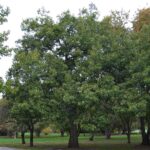
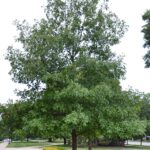
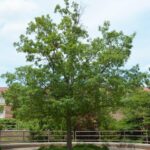
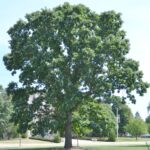
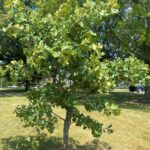
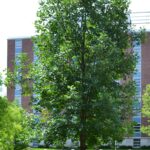
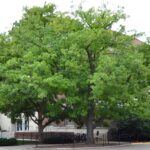
Tree Indiana Native Audio Recording AvailableID That Tree Video AvailablePurdue Plant Doctor Available Quercus rubra [Northern Red Oak] One of the best and most reliable of oaks as a shade or street tree. More vigorous and fast-growing than most oaks. Good street tree since it performs reasonably well in small soil volumes (although it tends to branch close to ground). Oak wilt disease has been troublesome in certain areas of the Midwest. Hybridizes easily with other oaks (be careful of source). Indiana NativeAudio Recording AvailableID That Tree Video AvailablePurdue Plant Doctor Available
Tree Indiana Native Audio Recording AvailableID That Tree Video AvailablePurdue Plant Doctor Available Quercus shumardii [Shumard Oak] The Shumard Oak is a handsome tree that is drought and air pollution tolerant, and but can also be used in rain gardens. Transplanting and establishment can be difficult. Indiana NativeAudio Recording AvailableID That Tree Video AvailablePurdue Plant Doctor Available
Tree Indiana Native Audio Recording AvailableID That Tree Video AvailablePurdue Plant Doctor Available Quercus stellata [Post Oak] A tough find in Indiana and mostly encountered in the wild throughout the southern states, the native Post Oak can be found in oak-hickory forests of southern Indiana. Open grown trees have a dense, round-topped crown with spreading branches for shade. Bark is similar to the White Oak, gray-brown in color with flat ridges, somewhat scaly, eventually ridged and furrowed. Fall color can vary, ranging from deep red to a golden brown. Indiana NativeAudio Recording AvailableID That Tree Video AvailablePurdue Plant Doctor Available
Tree Indiana Native Audio Recording AvailableID That Tree Video AvailablePurdue Plant Doctor Available Quercus velutina [Black Oak] Quercus velutina is a large, deciduous oak with an irregular canopy. It is closely related to Q. rubra (Red Oak), which it is known to hybridize with. The interesting bark of the Q. velutina is nearly black and furrowed. Transplanting is made difficult by the long tap root. Not generally sold commercially. Indiana NativeAudio Recording AvailableID That Tree Video AvailablePurdue Plant Doctor Available
Shrub Indiana Native Audio Recording AvailableID That Tree Video AvailablePurdue Plant Doctor Available Rhus aromatica [Fragrant Sumac] A highly variable species in both ultimate height and fall foliage color. Color probably also varies with soil type, possibly as a function of moisture content. Plants are native to dry, sandy, and rocky soils, and usually color well under these conditions. Useful for bank stabilization since it develops roots on stems touching the soil. It also suckers. Can spread too quickly for some sites (spreading rhizomes). Shear to ground to rejuvenate (try a brush-hog). Indiana NativeAudio Recording AvailableID That Tree Video AvailablePurdue Plant Doctor Available
Shrub Indiana Native Audio Recording AvailableID That Tree Video AvailablePurdue Plant Doctor Available Rhus copallinum [Flameleaf Sumac] The Flameleaf Sumac is a large shrub or small tree known for its extraordinary, "flaming" red fall color. Its form is initially compact, but then becomes quite open and irregular with age. Spreads by root suckers and forms large colonies, making it inappropriate for small areas. Indiana NativeAudio Recording AvailableID That Tree Video AvailablePurdue Plant Doctor Available
Shrub Indiana Native Audio Recording AvailableID That Tree Video AvailablePurdue Plant Doctor Available Rhus glabra [Smooth Sumac] Large, club-like fruit clusters and rather coarse compound leaves make this a plant that can best be appreciated from a distance, and so it is at its best in large-scale plantings. Picturesque branches. Hard to kill this plant. Can be rejuvenated by cutting to ground in late winter. Plants are dioecious, so only females have the fruiting interest, but all plants are reliably colorful in fall foliage. Spreads rapidly by suckers. Indiana NativeAudio Recording AvailableID That Tree Video AvailablePurdue Plant Doctor Available
Shrub/Tree Indiana Native Purdue Plant Doctor Available Rhus typhina [Staghorn Sumac] Indiana NativePurdue Plant Doctor Available
Shrub Indiana Native Purdue Plant Doctor Available Ribes americanum [American Black Currant] American Black Currant is a shade and wet soil tolerant shrub species often found in our Indiana woodlands. Small greenish-white flowers bloom in May which leads to dark red to black fruits that ripen in late August/September. When placed in full sun, a brilliant reddish orange fall color is produced but often golden yellow in the fall. The edible fruits are used in jams and jellies and are desirable food source for wildlife. An alternative… Indiana NativePurdue Plant Doctor Available
Shrub Indiana Native Audio Recording AvailablePurdue Plant Doctor Available Robinia hispida var. fertilis [Bristly Locust] Can fix nitrogen. Especially well adapted to poor, dry, alkaline soils. Though native, can be invasive on sandy soils. Frequent pruning may be needed. Indiana NativeAudio Recording AvailablePurdue Plant Doctor Available