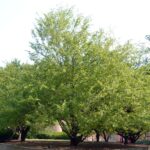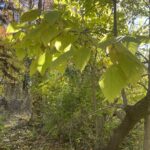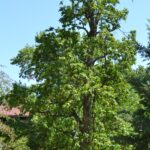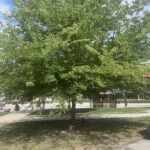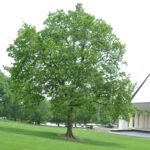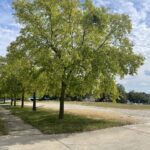
Tree Indiana Native Audio Recording AvailableID That Tree Video Available Carpinus caroliniana [American Hornbeam] A clean, trouble-free small tree, useful in intensive situations such as patios and malls, and equally interesting in naturalized plantings. Useful as a large hedge if coppiced when young. Performs well in heavy shade and tolerates periodic flooding. Difficult to transplant. Move balled-and-burlapped for best results. Sometimes called Blue Beech and Ironwood (although these are best not used). Indiana NativeAudio Recording AvailableID That Tree Video Available
Tree Carpinus caroliniana 'CCSQU' [sold as Palisade®™] [Palisade® American Hornbeam] Palisade is an upright, narrow, oval habit cultivar that is noted for its strongly ascending branches. Its dark green leaves changes to a soft golden color in the fall. A clean, trouble-free small tree, useful in intensive situations such as patios and malls, and equally interesting in naturalized plantings. Useful as a large hedge if coppiced when young. Performs well in heavy shade and tolerates periodic flooding. Difficult to transplant. Move balled-and-burlapped for best results.
Tree Purdue Plant Doctor Available Catalpa ovata [Chinese Catalpa] The Chinese Catalpa is smaller than other Catalpa species, generally only reaching 30 feet. It produces attractive yellow-white flowers in the spring, but they are not as ornamental as those of other Catalpa species. Its coarse winter trunk and branches are bold and striking; picturesque, but can be too coarse for many urban landscapes. Best for difficult areas. Wood is rot resistant, but is somewhat brittle so branches can fall in wind and ice storms.… Purdue Plant Doctor Available
Tree Indiana Native Audio Recording AvailableID That Tree Video AvailablePurdue Plant Doctor Available Catalpa speciosa [Northern Catalpa] Coarse winter trunks and branches are bold and striking; picturesque. Best for difficult areas. Wood is rot resistant, but is somewhat brittle so branches can fall in wind and ice storms. Too coarse of texture for most urban landscapes. Short-lived to about 50 years. Indiana NativeAudio Recording AvailableID That Tree Video AvailablePurdue Plant Doctor Available
Tree Indiana Native Audio Recording AvailableID That Tree Video AvailablePurdue Plant Doctor Available Celtis laevigata [Sugar Hackberry] The Sugar Hackberry is very similar to the Common Hackberry (Celtis occidentalis) and is especially useful in large-scale situations with dry soils and heavy winds. This species gained its common name from the juicy, sweet berries it produces. Subject to a leaf nipple gall (caused by psyllid insect Pachypsylla dismamma, one of many jumping plant lice). However, the Sugar Hackberry is more resistant to witches'-broom disease (caused by Eriophyid mite) than the Common Hackberry. Especially… Indiana NativeAudio Recording AvailableID That Tree Video AvailablePurdue Plant Doctor Available
Tree Indiana Native Audio Recording AvailableID That Tree Video AvailablePurdue Plant Doctor Available Celtis occidentalis [Common Hackberry] As well adapted to Midwestern conditions as American Elm, and a reasonably good substitute in form as well. Especially useful in large-scale situations with dry soils and heavy winds. Subject to a leaf nipple gall (caused by psyllid insect Pachypsylla dismamma, one of many jumping plant lice) and witches'-broom disease (caused by Eriophyid mite), both minor in most situations in the Midwest. Especially coarse texture limits use in designed landscapes. Indiana NativeAudio Recording AvailableID That Tree Video AvailablePurdue Plant Doctor Available
Tree Audio Recording AvailablePurdue Plant Doctor Available Celtis occidentalis 'Prairie Pride' [Prairie Pride Hackberry] As well adapted to Midwestern conditions as American Elm, and a reasonably good substitute in form as well. Especially useful in large-scale situations with dry soils and heavy winds. 'Prairie Pride' has glossy, thick, leathery leaves and is less of a litter problem than the species type due to its lower fruit production. Subject to a leaf nipple gall (caused by psyllid insect Pachypsylla dismamma, one of many jumping plant lice), but is not subject… Audio Recording AvailablePurdue Plant Doctor Available
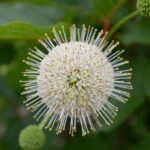
Shrub Indiana Native Audio Recording AvailableID That Tree Video Available Cephalanthus occidentalis [Common Buttonbush] Buttonbush is an Indiana native and a wet-soil tolerant shrub found near marshes, wetlands, and river banks. This is a great choice for those wet areas in the landscape or a featured shrub in your rain garden. The flowers of this shrub are globe-like in shape and bloom from June through August, attracting wildlife such as butterflies. The leaves of the Buttonbush emerge late in the Spring and might look dead until mid-May. Though this… Indiana NativeAudio Recording AvailableID That Tree Video Available
Shrub Indiana Native Audio Recording Available Clethra alnifolia [Summersweet Clethra] Spreads by underground stems to make large clumps, but can be restrained when necessary. Can be badly infested with mites, especially on dry soils. Can suffer in full sun and/or dry soils, but can bloom well in shade. Indiana NativeAudio Recording Available
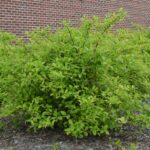
Shrub Clethra alnifolia 'Compacta' [Compact Summersweet Clethra] Only growing to 2-4' high and wide, Clethra alnifolia 'Compacta' is denser and more compact than the straight species. This plant can suffer in full sun and/or dry soils, but can bloom well in shade.