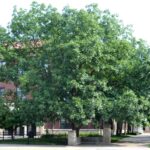
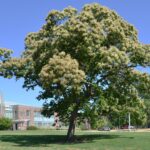
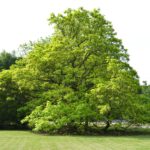
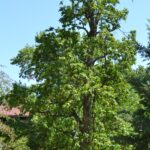
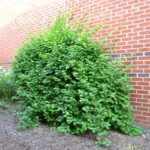
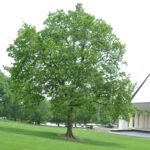
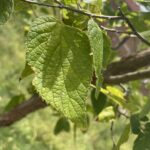
Tree Indiana Native Carpinus caroliniana [American Hornbeam] A clean, trouble-free small tree, useful in intensive situations such as patios and malls, and equally interesting in naturalized plantings. Useful as a large hedge if coppiced when young. Performs well in heavy shade and tolerates periodic flooding. Difficult to transplant. Move balled-and-burlapped for best results. Sometimes called Blue Beech and Ironwood (although these are best not used).
Tree Indiana Native Carya cordiformis [Bitternut Hickory] Carya cordiformis is naturally found growing in low woodlands and along rivers, streams, and ponds. This is one of the fastest growing of the hickories. The long taproot can make this species difficult to transplant. There are no serious insect or disease threats.
Tree Indiana Native Carya ovata [Shagbark Hickory] The bark of Carya ovata gives the tree its common name and is characteristically rough and shaggy on mature trees, growing in long flat plates, making especially good winter interest. The wood of this tree is especially hard, making it useful for a variety of products. This tree develops a large taproot, making it difficult to transplant.
Tree Carya × nussbaumeri [Hican] This tree is a hybrid of the pecan and shellbark hickory, thus the common name of "Hican". It was developed to produce a nut with the taste of pecans, but with the weaker shell of the shellbark hickory. This plant has a large tap root and can be difficult to transplant. Dropped fruits, stems, and leaves can be a litter problem. Can be prone to various fungal leaf spots.
Tree Castanea mollissima [Chinese Chestnut] Overall tough and durable, but can be susceptible to blight, twig canker, and orient chestnut wasp. Also susceptible to weevils, which damages the roots. Prefers well-drained, loamy soils, full sun, and hot, arid conditions.
Tree Catalpa bignonioides 'Aurea' [Golden Southern Catalpa] The Golden Southern Catalpa can tolerate full sun, but does best in part sun to part shade. This species is weak wooded and should not be placed where it is open to wind and storm damage. 'Aurea' is known for its rich yellow leaf coloration and its broad form. Its flowers are trumpet shaped and white with yellow and purple spots.
Tree Indiana Native Catalpa speciosa [Northern Catalpa] Coarse winter trunks and branches are bold and striking; picturesque. Best for difficult areas. Wood is rot resistant, but is somewhat brittle so branches can fall in wind and ice storms. Too coarse of texture for most urban landscapes. Short-lived to about 50 years.
Liana (Climbing Vine) Indiana Native Celastrus scandens [American Bittersweet] Sun to partial shade (best flowers in full sun), and tolerant of soil conditions (except wet). Tends to be invasive. Birds are fond of fruits. Tends toward dioeciousness. Female plants need a male pollinator to produce more abundant fruits. Can girdle trees it grows on. Euonymus scale and two-marked treehoppers can cause damage.
Tree Indiana Native Celtis occidentalis [Common Hackberry] As well adapted to Midwestern conditions as American Elm, and a reasonably good substitute in form as well. Especially useful in large-scale situations with dry soils and heavy winds. Subject to a leaf nipple gall (caused by psyllid insect Pachypsylla dismamma, one of many jumping plant lice) and witches'-broom disease (caused by Eriophyid mite), both minor in most situations in the Midwest. Especially coarse texture limits use in designed landscapes.
Tree Celtis occidentalis 'Chicagoland' [Chicagoland Hackberry] Develops a single upright leader, a 15-year-old tree was 26' high and 14' wide, a chance seedling selected by Roy Klehm, South Barrington, IL.