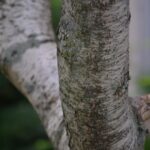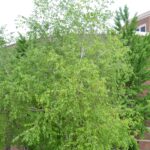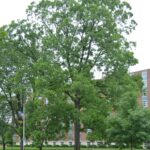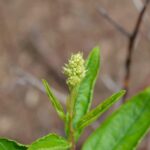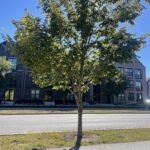
Tree Betula nigra 'Cully' [sold as Heritageā¢] [Heritage River Birch] This vigorous cultivar makes a graceful tree, interesting for its richly colored, strongly curling bark and large, glossy leaves. It is somewhat resistant to leaf spot and is especially well adapted to wet soils. Immune to the bronze birch borer, which is a serious problem for the native Betula papyrifera in the Midwest. This species prefers full sun and is quite heat tolerant, but does not have tolerance for drought. If pruning is required, prune…
Tree Betula 'Penci 2' [sold as Royal Frost®] [Royal Frost Birch] A hybrid between Betula populifolia 'Whitespire' and Betula 'Crimson Frost', popular for its colorful foliage that is red/purple spring and summer and yellow/orange in the fall, and its interesting bark characteristics.
Tree Betula pendula ssp. mandshurica [Asian White Birch] A generally better choice than the species type, Betula platyphylla var. japonica is a larger, graceful tree with thinner, spreading branches and striking pure white bark. It is especially well adapted to wet soilsand does not do well in dry situations. Less subject to the borer troubles of B. papyrifera in the Midwest, although still susceptible.
Tree Indiana Native Betula populifolia [Gray Birch] Beautiful white bark, although becomes dirty gray with age. Does well on the poorest of sterile soils, seeds, and suckers quickly. Grows on sandy, rocky and even gravelly sites. Tolerates both wet and dry conditions. Prefers full sun. Susceptible to leaf miner and cankers; more resistant to the bronze birch borer. Leaf minors especially problematic.
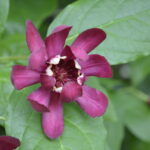
Shrub Calycanthus floridus 'Aphrodite' [Aphrodite Sweetshrub] 'Aphrodite' has an upright form with deep red flowers. The flowers are fragrant and large and bloom throughout the summer season. Large bright green leaves, can grow to be bigger than a human hand.
Tree Indiana Native Carpinus caroliniana [American Hornbeam] A clean, trouble-free small tree, useful in intensive situations such as patios and malls, and equally interesting in naturalized plantings. Useful as a large hedge if coppiced when young. Performs well in heavy shade and tolerates periodic flooding. Difficult to transplant. Move balled-and-burlapped for best results. Sometimes called Blue Beech and Ironwood (although these are best not used).
Tree Indiana Native Carya glabra [Pignut Hickory] With its straight trunk and strong, hard wood, the Pignut Hickory is most commonly grown for the lumber industry and is not generally used as an ornamental tree. In the wild, it tends to grow on ridges and hillsides in dry to moist soils. This large tree needs a great deal of room to grow and transplants poorly due to its large taproot. The nuts are generally too bitter for humans to eat, but are…
Tree Indiana Native Carya illinoinensis [Pecan] The Pecan is a tall, straight-trunked tree and is the largest of the hickories. It is well-known for its sweet, edible nuts and because of this, it is an important horticultural crop in the south, where it produces fruit most abundantly. However, it is not generally recommended for use in the landscape, due to its pest susceptibility and litter problem. With its large taproot, it can also be quite difficult to transplant.
Shrub Indiana Native Ceanothus americanus [New Jersey Tea] New Jersey Tea is a native prairie plant that has thick, deep-reaching, red roots (which can even grow up to 8" in diameter), making it very drought tolerant, but also difficult to transplant. This small, compact shrub is able to fix atmospheric nitrogen and is quite adaptable, not only tolerating drought, but different soil types as well. It is even capable of growing in sandy and rocky soils. The leaves of New Jersey Tea were…
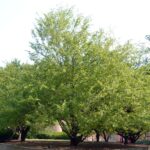
Tree Celtis occidentalis 'Magnifica' [Magnifica Hackberry] 'Magnifica' is a cultivar with a yellow fall color, fast growth rate, and more disease resistance than its parents. As this tree matures it gets sandpaper-yellow speckled leaves and rough bubbled gray bark.