
Deadhead To remove spent flowers from a plant in order to improve appearance or prevent self-seeding. Did you know? Deadheading petunias, roses, and dahlias can extend bloom because the plant keeps producing flowers instead of maturing seeds.
Arboretum Botanical Glossary
A botanical reference guide of morphological terms, plant structures, propagation techniques, and campus flora definitions.
Browse by Subject Category
Explore terms organized by botanical structure, morphology, and arboricultural concepts.
Decumbent Lying flat on the ground but with the tip pointing up.
Decurrent Extending downward from the point of attachment, as in a leaf base that extends down along the stem. In mushrooms, pertaining to the attachment of the gills to the stipe (stem), in which the gills curve partly down the stipe towards the base of the stipe.
Dehiscence The splitting open of an anther or seed pod. This feature helps explain how flowers are arranged, how pollination happens, or how seeds begin to form. Did you know? Some seed pods explosively dehisce, flinging seeds away from the parent plant.
Deliquescing The process by which gills in the mushroom genus Coprinus (Ink Caps) rapidly break down into a black ink-like liquid, droplets of which disperse spores
Deltate Shaped like an equilateral triangle. This feature helps describe plant form, function, or identification.
Dentate Toothed. This feature helps describe plant form, function, or identification.
Depauperate Stunted or poorly developed. This feature helps describe plant form, function, or identification.
Dextrinoid A type of chemical staining reaction in which the tissues of certain fungi (spore wall ornamentation, etc.) stains reddish to reddish-brown in Melzer's reagent.
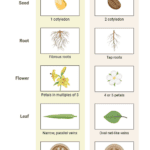
Dicotyledon A dicotyledon (commonly known as a dicot) is a flowering plant that begins life with two seed leaves, called cotyledons. Dicots typically have broad leaves with branching veins, flower parts in multiples of four or five, and a taproot system. Many trees, shrubs, wildflowers, and garden plants are dicots, including oaks, maples, roses, and sunflowers. Did You Know? Most of the trees found in…